FADU puts the filesystem inside the SSD's flash to bypass host CPUs
FADU’s FS-SSD carries NFSv3 file operations inside NVMe commands, letting GPUs, DPUs, and NICs read files without a host file system.
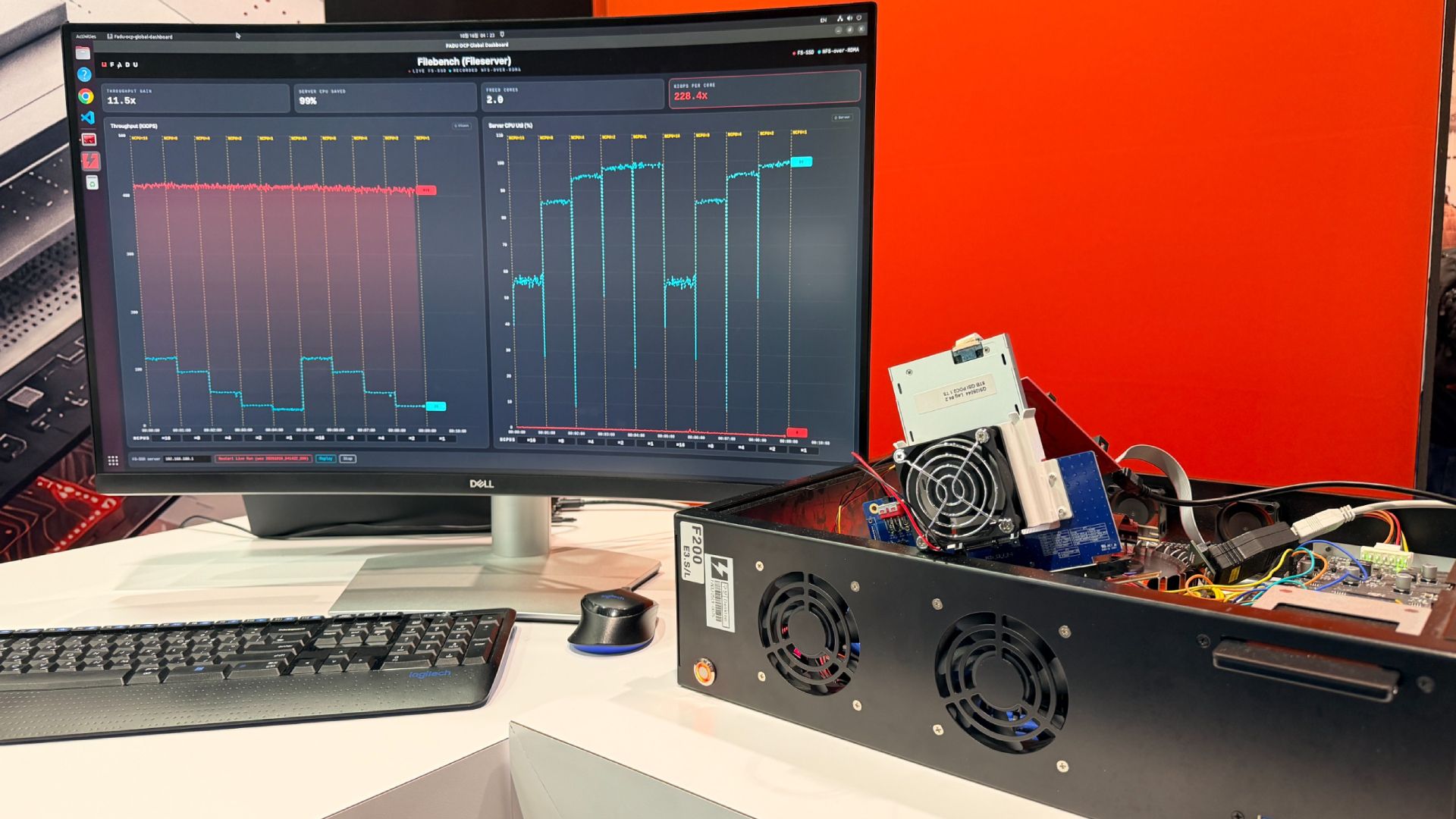
FADU, a Korean SSD controller designer, has unveiled its innovative File-Semantic SSD (FS-SSD), which integrates the file system directly into the SSD, eliminating the need for a host CPU to manage file operations. This technology allows GPUs, DPUs, and NICs to access files directly without passing through the host filesystem, block layer, or storage-server CPU.
FADU anticipates delivering samples to partners by Q3 2027. The FS-SSD technology focuses on optimizing the control path while leveraging existing accelerators for the data path. Preliminary tests show that the file system and block layers together consume approximately 30% of CPU cycles in a GPUDirect Storage (GDS) random-read workload.
FADU's FS-SSD outperforms traditional Linux NFS-over-RDMA, which sees a significant drop in performance when moving from 16 cores to a single core, whereas FS-SSD maintains approximately 460,000 operations per second. The FS-SSD supports PCIe 5.0 and offers NVMe-oF over RDMA and TCP, utilizing an existing protocol for efficient data transfer.
The file system and flash translation layer are merged with a file layer derived from F2FS, aligning node and data blocks with natural flash pages. FADU's FS-SSD claims a 63% reduction in write amplification compared to a host F2FS solution, providing a more efficient storage solution.
Written by urgent.news from Tom's Hardware's reporting — not their text. Machine-written — may contain errors; check the original before relying on it.