The Physics Behind Tesla’s Flying Roadster
To understand how Elon’s new car hops, glides, and sticks upside down, we need to talk about friction and force.
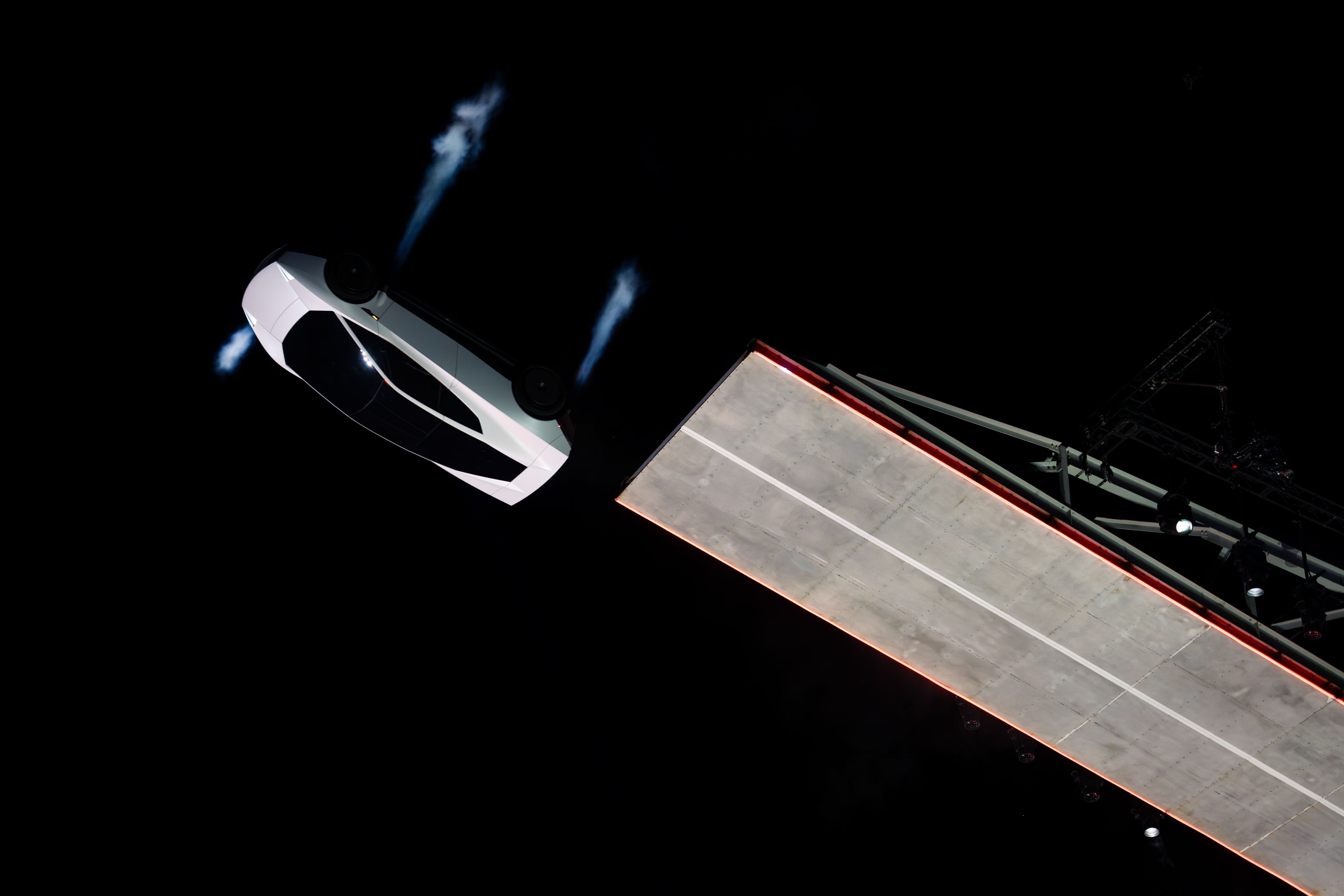
Last week, Elon Musk unveiled Tesla's delayed Roadster 2, which can soar through the air and perform feats beyond normal cars. However, two questions arise: should humans drive up walls and into the air, and how did the Roadster 2 prototype accomplish these feats? The physics behind the prototype's abilities can be explained.
Driving up a wall is possible due to increased friction. When two surfaces interact, like rubber tires and a road, static friction prevents sliding. The frictional force depends on the normal force (the force pushing the surfaces together) and the coefficient of static friction (μ), which describes the materials interacting. For rubber on asphalt, μ is around 0.6. The maximum angle a car can drive up without slipping is about 31 degrees, even with a high μ value of 0.9.
The Roadster 2 overcomes this limitation by using fans to create a pressure difference under the car, generating a normal force equal to the gravitational force. This allows the car to stick to a vertical wall. Additionally, the suction effect can improve acceleration and braking performance on normal roads.
The Roadster 2 also boasts an impressive acceleration from 0 to 60 mph in less than a second. Traditional cars cannot achieve this due to their reliance on frictional force, which is limited by the coefficient of friction. Tesla's prototype relies on compressed air shot out the back, similar to how rockets work. By releasing compressed air, the car experiences a force pushing it back, propelling it forward—a principle known as Newton's third law.
In summary, Tesla's Roadster 2 prototype demonstrates the potential of using physics to push the boundaries of automotive performance. While driving up walls and flying are not practical for everyday use, the principles behind these feats can improve acceleration and handling on normal roads.
Written by urgent.news from Wired Science's reporting — not their text. Machine-written — may contain errors; check the original before relying on it.