China’s new 0.1-nanometre electron microscope ready to challenge US and Japan
China is ready to commercialise a 200-kilovolt transmission electron microscope with an information resolution down to 0.1 nanometres that could introduce a new challenger into a market long dominated by the US and Japan. Developed by Hefei-based manufacturer CIQTEK, the microscope features a point resolution of 0.25nm and an information limit of 0.1nm – on par with leading workhorse models on…
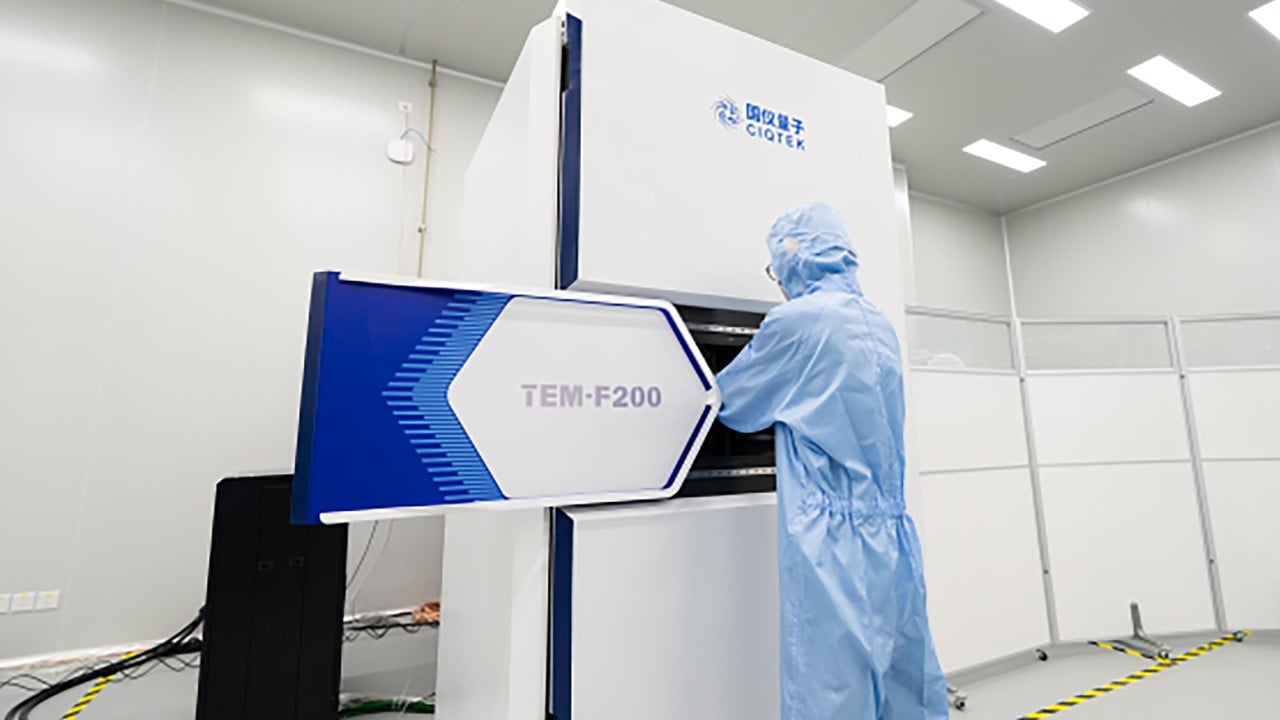
China has unveiled a new 200-kilovolt transmission electron microscope capable of resolving details as small as 0.1 nanometres. Developed by Hefei-based manufacturer CIQTEK, the TEM-F200 features a point resolution of 0.25 nanometres, matching the capabilities of leading models from US and Japanese firms. This marks a shift from research and development to commercial development in China's rapidly growing electron microscopy industry, aiming to reduce dependence on imported technology.
CIQTEK's chairman, He Yu, highlighted the microscope's potential for high-resolution imaging and defect analysis of advanced materials and semiconductors. Wu Aihua, secretary general of the China Instrument and Control Society, noted its potential applications in biomedicine and self-sufficiency in advanced analytical testing. The development of electron microscopes, which use electron beams instead of light to visualise structures beyond human vision, began in the 17th century and was revolutionised in the early 1930s with the creation of the first electron microscope.
Modern TEMs, operating at around 200kV, strike a balance between resolution and sample damage, finding applications in materials science, life sciences, and nanotechnology. The global market for commercial TEMs is currently dominated by US and Japanese companies, including Thermo Fisher Scientific and Japanese developer JEOL. China has been rapidly advancing its electron microscope capabilities in recent years, with the country now producing its first commercial 200kV TEM, the TEM-F200, and a 120kV model for life sciences and materials research.
Written by urgent.news from South China Morning Post's reporting — not their text. Machine-written — may contain errors; check the original before relying on it.