AI Alone Won’t Fix Your Legacy System Migration Strategy
Learn where AI helps with legacy application modernization, from code analysis to data migration, and why architecture still requires human oversight.
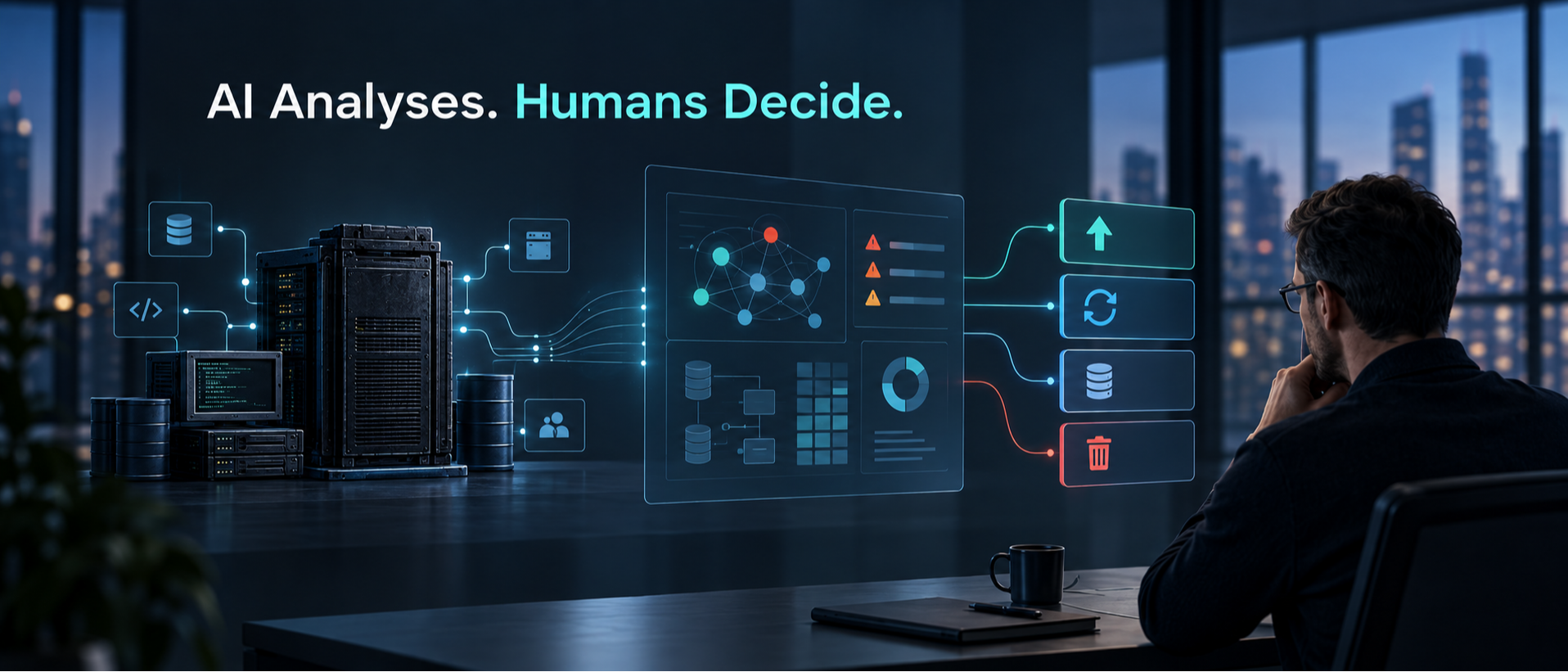
While artificial intelligence can perform a multitude of tasks related to legacy system migration, it cannot solely handle the process. Legacy applications are often composed of extensive codebases, decades of changes, undocumented dependencies, complex databases, and intricate integrations that are difficult for a human to comprehend. Moreover, AI can process and classify large volumes of code faster than a human team can, but this is only the beginning of the migration problem.
Understanding what a legacy system does is not equivalent to deciding what should happen to it. AI can reveal which code exists, which services are connected, what dependencies are present, what components are heavily referenced, where potential security issues may lie, and what code can potentially be transformed. However, the migration team must determine whether a component should remain, be rebuilt, or be retired, as well as decide on the appropriate migration strategy, acceptable risks, and the future architecture. These critical decisions are best left to human professionals.
Legacy migration is not merely a coding issue; it is an architectural challenge. Legacy applications often consist of a myriad of technicalities and are frequently interconnected with various systems, including databases, APIs, authentication services, reporting tools, scheduled processes, third-party platforms, and other internal applications.
Some connections may be well-documented, while others can only be traced through configuration files, deployment scripts, and the knowledge of long-term maintainers. This complexity is why legacy migration is fundamentally an architectural problem, not just a coding problem.
To effectively address legacy migration, the migration team must first perform an assessment of the application, infrastructure, data, integrations, dependencies, and business rules before designing the target environment. Various cloud migration strategies can be employed, typically categorized as the 7Rs: Rehost, Replicate, Refactor, Repurchase, Relocate, Retain, and Retire.
AI can significantly assist with legacy migration by reducing repetitive analysis and synthesis work that engineers would otherwise perform manually. Modernization tooling employs AI to perform tasks such as code analysis, documentation generation, dependency analysis, business-logic extraction, and code transformation. For example, AI can help identify out-of-date frameworks, duplicated logic, potentially unused components, API calls, potential security issues, and complex functions.
This assistance enables the migration team to obtain a preliminary understanding of the application's structure before making any modifications.
Additionally, AI can generate module descriptions, API documentation, code comments, dependency summaries, and architecture notes, which can significantly reduce the manual effort required to create an initial system inventory.
Written by urgent.news from HackerNoon's reporting — not their text. Machine-written — may contain errors; check the original before relying on it.