Wirtschaftspolitik: Roter Teppich: Wie Kanzler Merz um Investoren wirbt
Die Bundesregierung zieht alle Register, um mehr Investoren nach Deutschland zu locken. Eine Konferenz soll ein „Willkommens-Signal“ senden. „Stargast“ des Eröffnungsabends ist der Nvidia-Chef.
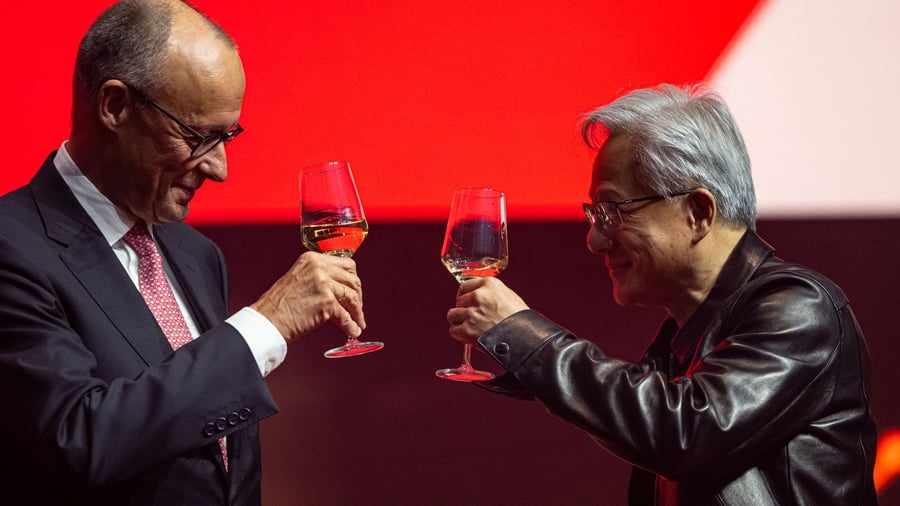
Bundeskanzler Friedrich Merz (CDU) hosted an investment summit in a former DDR government building in Berlin's Schlossplatz. The event, dubbed the "Red Carpet for Investments," aimed to attract private investments from around the world. Merz emphasized that Germany is open to investments, business, and ready to grow faster. The event featured Nvidia CEO Jensen Huang, who agreed to collaborate with the German government on Artificial Intelligence (AI) projects.
The summit brought together over 200 international and German executives from major corporations, investment banks, and funds. The German government plans to inject billions into infrastructure and support companies transitioning to more climate-friendly processes. However, economic experts warn that a sustainable economic recovery is still needed.
Christian Sewing, CEO of Deutsche Bank, stated that Germany faces a historic investment challenge that cannot be met solely with public funds. The government aims to mobilize more private capital for investments in areas like machinery and equipment, research and development, modern production sites, and software to boost productivity and economic growth.
Merz invited investors to participate in Germany's largest modernization offensive. The event served as a "welcome signal" to international investors, highlighting Germany's solid finances, stable legal system, highest patents among European countries, top universities, skilled workforce, and EU's single market. However, there is room for improvement, with a 6.4% decline in total investments in Germany between 2019 and 2025, compared to a 6.7% increase in the Eurozone and a 20.2% increase in the US.
Investment hesitancy in Germany is attributed to high energy costs, high tax and duty burden, and excessive bureaucracy. The focus of the summit was on the industrial AI, which Germany lacks in large language models but has significant potential due to its industrial base and data availability. Nvidia's Jensen Huang expressed confidence in Germany as a location, having invested nearly a billion dollars in the country last year and involved in numerous startups and established companies.
Merz pledged to continue the government's reform course, including reforms in social systems, digitalization of administration, labor market flexibility, and shorter planning and approval procedures for data centers. However, some reforms, such as the pension reform, are controversial within the red-green coalition. DIHK's Volker Treier emphasized that the investment summit is a significant signal, but it is crucial for the government to improve the location conditions for lasting additional investments.
Michael Hüther, Director of the German Institute for Economic Research, stated that companies decide on Germany based on earning potential, not just a promotional event. Merz remains optimistic about Europe catching up with the US and China, stating, "We are a large market with 450 million consumers, which is 100 million more than the combined population of the US and China."
Written by urgent.news from Handelsblatt's reporting — not their text. Machine-written — may contain errors; check the original before relying on it.