The Chemistry in Stellar Nurseries is Complex, and a New 3D Model Highlights It
Young stars form in molecular clouds, and once they're turned on, they begin to shape their natal clouds with radiation. Researchers developed a new 3D model of one feature of the Orion Nebula star-forming region called the Orion Bar. Their model matches JWST observations, and explains how the uneven structure in stellar nurseries creates shadowed regions that alters the astrochemistry in the…
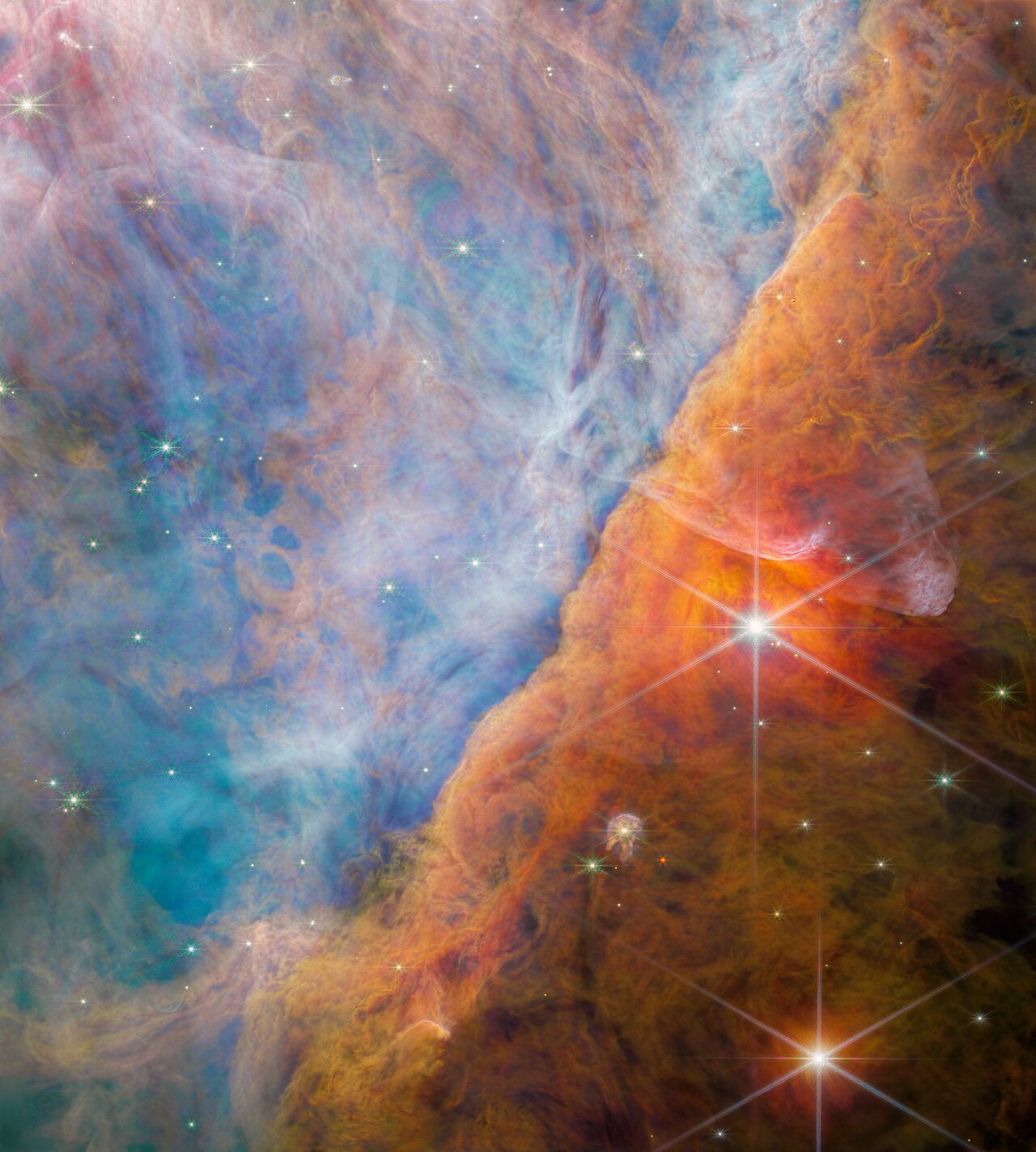
The complex chemistry within star-forming regions, known as photodissociation regions (PDRs), is the focus of a new 3D model that provides insights into the structure and processes at play. Molecular hydrogen (H2) is the raw material for star formation, occurring in large clouds called Giant Molecular Clouds (GMCs). As young stars form and emit radiation, they heat up and disperse surrounding gas, establishing a barrier that prevents further star formation. This behavior, however, also influences the overall chemistry and structure of GMCs.
The Orion Bar, a ridge of gas and dust in the Orion Nebula, serves as a prototypical PDR for decades, offering a unique view of the atomic-to-molecular transition in the interstellar medium. By examining the region, researchers have discovered that the molecular hydrogen photodissociation front overlaps with the C+ recombination front, a layer where ionized carbon converts to neutral carbon. This finding emphasizes the importance of accurate modeling for understanding GMCs and stellar feedback's role in shaping them.
A team of researchers, led by Dr. Brandt Gaches from the University of Duisburg-Essen, has developed a fully three-dimensional high-resolution model of an Orion Bar analog. This model captures the complex, clumpy, and messy reality of GMCs, revealing the intricate spatial distribution of H2 dissociation and C+ recombination fronts. The H2 dissociation front, shown in red, and the C+ recombination front, shown in cyan, coexist in some regions—a discovery that has important implications for astrochemistry.
This coexistence leads to excited-state hydrocarbon chemistry, creating compounds like methane, acetylene, and polycyclic aromatic hydrocarbons (PAH). These compounds are significant building blocks for organic matter and act as essential carbon reservoirs. However, the primary focus of this research is on the morphology of GMCs and how photodissociation shapes it.
The researchers' 3D model successfully reproduces the complex H2 emission features observed in the Orion Bar, including arc- and filament-like structures. The model demonstrates that the three-dimensional gas structure creates shadows and shields parts of the cloud from intense radiation, altering the chemistry and leaving a distinctive infrared to radio wavelength signature in the observed light.
As scientists create models that align with observations, they inch closer to a deeper understanding of stellar nurseries. This model, while not primarily designed to fit the Orion Bar's observations, does successfully reproduce many of these features. The findings mark a turning point for astrochemistry, as three-dimensional steady-state models provide new insights into the chemistry and structure of the interstellar medium.
Future research can now explore gas morphologies and their photochemical reactions in three dimensions, further enhancing our understanding of the complex processes occurring within GMCs.
Written by urgent.news from Universe Today's reporting — not their text. Machine-written — may contain errors; check the original before relying on it.