Symposium highlights MIT’s wide range of innovations for aging brain health
In six talks, researchers from across MIT described projects aimed at advancing the understanding of and interventions against neurodegenerative diseases such as Alzheimer’s, Parkinson’s, and ALS.
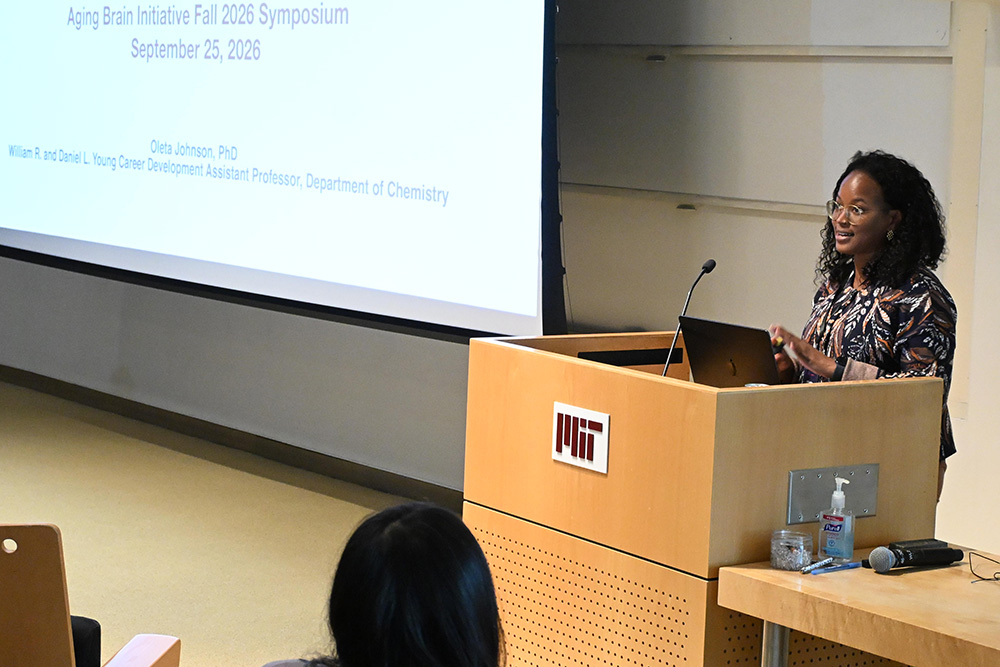
The MIT Aging Brain Initiative (ABI) convened researchers from diverse fields on September 25 for its symposium "Innovations for the Aging Brain." The premise of the ABI since 2015 has been that neurodegenerative diseases like Alzheimer's are complex "system-wide" issues requiring advances from many sources. Director Li-Huei Tsai highlighted the symposium as showcasing MIT's collective brilliance across neuroscience, engineering, chemistry, and beyond.
Giovanni Traverso, Karl Van Tassel Professor of Mechanical Engineering and a physician at Brigham and Women’s Hospital, spoke about his AI system, FINGERS-7B, that integrates clinical trial data, patient lifestyle histories, and multi-omics data to predict Alzheimer's progression and individual responses to interventions. He emphasized the unique biology of each person and the potential of AI to tailor prevention measures and inform clinical trials.
Picower Professor Earl Miller discussed preventing cognitive side effects from too much general anesthesia in older adults during surgery. His research with founding member Emery N. Brown used brain wave-based measurements to optimize anesthesia dosing, as multiple anesthesia drugs induce unconsciousness similarly by shifting brainwaves out of phase.
Associate Professor Ritu Raman from Mechanical Engineering described her work developing advanced lab models of muscle tissue integrating nerves and vasculature to study neuromuscular diseases like ALS and muscular dystrophies. Her lab created cultures from induced pluripotent stem cells derived from ALS patients to examine neuromuscular junctions in detail and model changes in response to therapeutic drugs.
Oleta Johnson, Young and Daniel L. (1995) Career Development Assistant Professor of Chemistry, focused on preventing protein aggregation before it begins in neurodegenerative diseases. Her lab develops chemical knowledge and methods to identify, detect problematic states, and control conformation of misfolded proteins like amyloid-beta and alpha-synuclein.
Alan Jasanoff, McDermott Professor in the Brain Sciences and Human Behavior, presented his lab's development of novel chemical probes to visualize molecules in the brain using magnetic resonance imaging. These include probes for neuromodulatory enzymes like cholinesterase, the target of Alzheimer's drugs, and lipids involved in Alzheimer's pathology. His lab also works on genetically encoding these probes in brain cells for improved MRI visualization of brain activity.
Finally, Laura Kiessling, Novartis Professor of Chemistry, discussed the role of glycans, sugars on cell surfaces, in Alzheimer's disease. Her lab, with founding member Ed Boyden, is characterizing glycans like heparan sulfate and how they organize and bind proteins on cell membranes, potentially contributing to the disease.
Written by urgent.news from MIT News Research's reporting — not their text. Machine-written — may contain errors; check the original before relying on it.