Instrumentation
To measure airflow and sound, research teams at the NASA Glenn Research Center use special instrumentation like particle image velocimetry, hot wire anemometry, Raman spectroscopy, microphones in phased arrays or continuously rotating rakes. The global aviation noise reduction community relies on data from NASA GRC experiments to validate theory and noise prediction software. Rotating Rake […]…
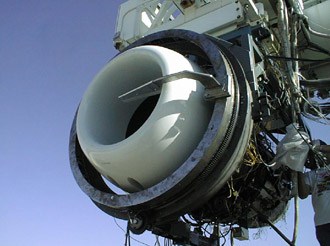
Instrumentation at NASA's Glenn Research Center utilizes various specialized tools to measure airflow and sound. These include particle image velocimetry, hot wire anemometry, Raman spectroscopy, and microphones arranged in phased arrays or continuously rotating rakes. The data collected through these methods is crucial for validating aviation noise reduction theories and software.
One such tool is the Rotating Rake Mode Measurement System (RRMS), a rotating microphone system pioneered by NASA Glenn engineers in the 1990s to gather detailed information about the modal content of annoying engine tones. This data is typically beyond the reach of stationary microphones, which is why rotating microphone rakes have been employed in a broad range of tests, from small-scale models to full-scale turbofan engines.
NASA Glenn has also developed a phased array system, known as Array48, capable of pinpointing noise sources in complex flows. This system, like the rotating microphone rake, can be 1D, 2D, or 3D in configuration, and its processed measurements allow for pinpoint accuracy in noise source identification. More recently, NASA has explored embedding microphones within an engine's fan duct to determine the location of noise sources on rotating blades.
Additionally, hotwire probes and Laser Doppler Velocimeters (LDV) are used to record detailed air velocity measurements upstream, downstream, and between the rotor and stator of an experimental propulsor. This data aids in identifying noise sources and mitigating them, and is crucial for validating calculations used to estimate noise from turbofan engines.
Written by urgent.news from NASA Science's reporting — not their text. Machine-written — may contain errors; check the original before relying on it.
Also reported by 1 other outlet
- Instrumentation nasa.gov