Engineer builds tiny 3D-printed single-motor drone in their bedroom
Joshua Bird designed, built, and tested this drone in their home, even resorting to building their own high-speed camera to check their build while spinning at a high speed.
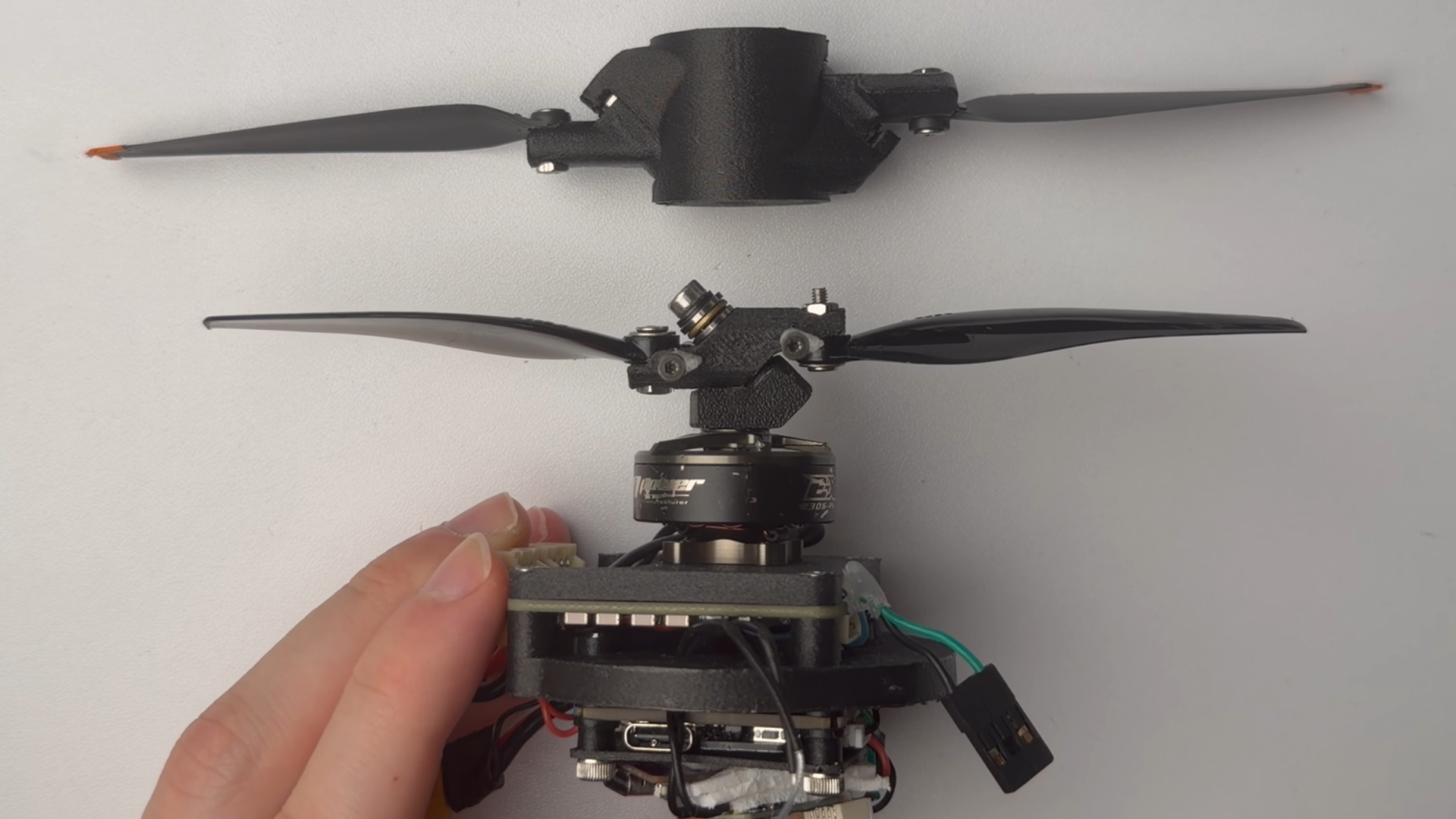
Joshua Bird, a software engineer with a passion for drones and 3D printing, has created a single-motor drone in his home and tested it on his bed. Bird shared a video detailing the process on YouTube, showcasing the innovative techniques used to ensure the drone's controllability and stability. The drone's design incorporates a hinged propeller, rapid motor speed adjustments, and custom firmware that allows the motor to respond to changes within 0.2 milliseconds.
Traditional rotary-wing aircraft rely on a swash plate and secondary propeller to counteract the torque generated by the motor, making them heavier and more complex. Bird's single-motor drone eliminates this need by continuously adjusting the motor's speed, utilizing increased speed for greater reaction torque and slower speeds to apply opposite reaction torque.
This method enables the drone to maintain stability by balancing these forces. The hinged rotor, with blades set at a 45-degree angle, allows for directional control as the blades pivot when the motor accelerates, adjusting lift on one blade while reducing it on the other.
In addition to roll and pitch control, Bird integrated the motor adjustments with yaw control using the drone's main rotor torque, adjustments, and 3D-printed stabilizing fins. To enhance control, Bird developed a high-speed camera using a Sony camera and a flash unit controlled by a microcontroller, which monitored the drone's motor controller and camera shutter. The camera revealed that the propellers were too flexible, requiring a sturdier 3D-printed replacement.
Bird conducted numerous test flights from his bed, with many resulting in crashes and wall damage as he fine-tuned the drone's programming. Despite these challenges, Bird successfully flew the 3D-printed drone, though its range was limited to his bedroom due to its fixed-base IR beacon navigation system. Future plans include adding a linear camera for operation in different environments.
While smaller, quieter drones have been developed by others, including a mosquito-sized unit by researchers in China, Bird's single-motor drone represents a distinct approach to drone design. The YouTube video not only demonstrates the drone's construction but also highlights Bird's innovative problem-solving skills and the solutions he implemented.
Viewers can find the complete video and access the Single Propeller Drone GitHub repository for a hands-on project.
Written by urgent.news from Tom's Hardware's reporting — not their text. Machine-written — may contain errors; check the original before relying on it.