APOD: 2026 October 19 – Treble Clef: Unusual X-ray Hot Radio Source
The post APOD: 2026 October 19 – Treble Clef: Unusual X-ray Hot Radio Source appeared first on NASA Science .
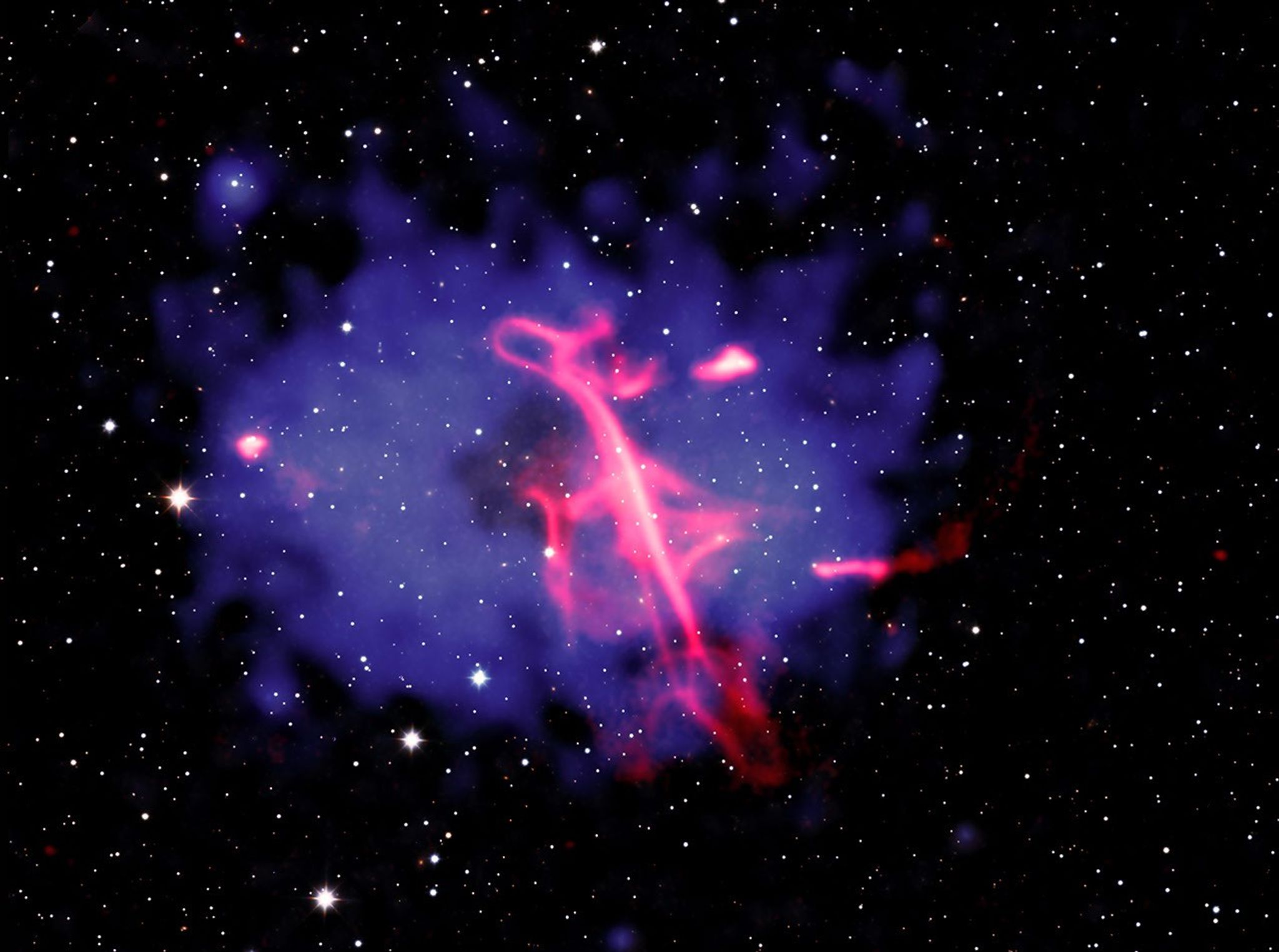
On October 19, 2026, an intriguing astronomical object known as Treble Clef was highlighted in the Astronomy Picture of the Day. Treble Clef is an unusual radio structure that stretches over 2 million light-years and bears a resemblance to a familiar musical symbol. However, its visible light is concealed by our Milky Way Galaxy.
Discovered in 2004, the exact nature of Treble Clef remained unknown until recent observations by the Chandra X-ray Observatory and eROSITA. These observations suggest that the central cloud of charged particles that forms Treble Clef was initially expelled by a supermassive black hole at the core of a galaxy. After the radio emission from these particles faded, they may have been reinvigorated by a shock wave generated by the collision of two galaxy clusters.
The featured composite image of Treble Clef displays radio emission in red and recently discovered X-rays in blue. Such objects as Treble Clef provide humanity with unexpected insights into the complex interactions between clusters of galaxies and the broader evolution of our universe.
The image was captured in red via the National Aeronautics and Space Administration's (NASA) Chandra X-ray Observatory, UKIDSS-GPS infrared instrument, and the ASTRON LOFAR radio telescope. Image processing was conducted by NASA's Chandra X-ray Center and the Smithsonian Astrophysical Observatory. The Astronomy Picture of the Day is a service of the Astroparticle Science Division at NASA/GSFC, NASA Science Activation, and Michigan Tech. The author and editor of today's image is Robert Nemiroff.
Written by urgent.news from NASA Science's reporting — not their text. Machine-written — may contain errors; check the original before relying on it.
Also reported by 1 other outlet
- APOD: 2026 October 19 – Treble Clef: Unusual X-ray Hot Radio Source science.nasa.gov