How land power could help US forces counter China in the Indo-Pacific
Senior US commanders have highlighted the importance of land-based troops and equipment stationed in the Asia-Pacific in any conflict with China, countering assumptions that such a war would be fought mainly at sea and in the air. General Ron Clark, commander of US Army Pacific, said the “tyranny of distance” made it difficult to rely on air and naval forces during a panel discussion at the…
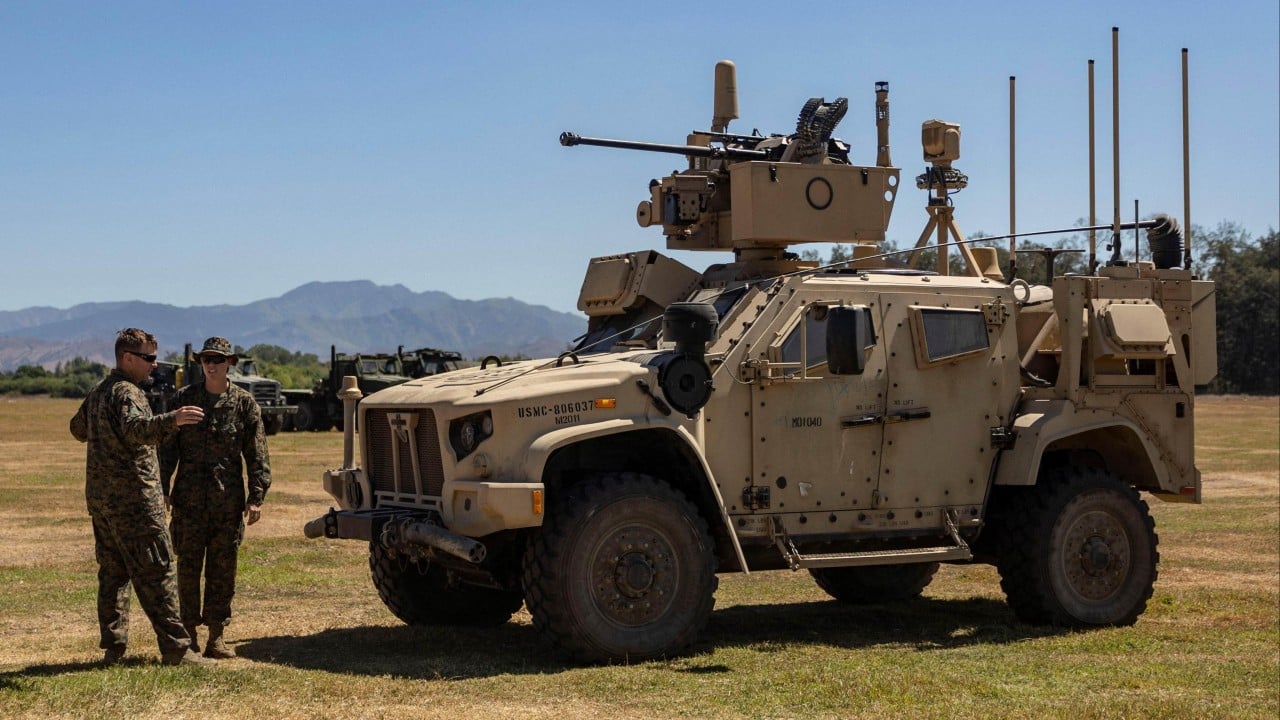
Senior US Army commanders have emphasized the critical role of land-based troops and equipment in the Asia-Pacific region in any potential conflict with China. General Ron Clark, commander of US Army Pacific, explained that the "tyranny of distance" makes it impractical to solely rely on air and naval forces during a conflict. He highlighted that China's growing air and naval capabilities could potentially hinder American forces' operations in the region, necessitating a greater dependence on land-based support.
Clark, who oversees over 107,000 soldiers in US Pacific territories and allies such as South Korea and Japan, explained that the command covers vast geographical areas, including 17 time zones, 52% of the Earth's surface, 60% of the Earth's population, and 25% of the world's land mass. US Army's combat-readiness, particularly in the first and second island chains, has proven effective in deterring Chinese aggression, he added.
Clark further explained that the Army now possesses the capability to operate across all domains within the first and second island chains, which are strategically vital groups of islands that separate China from the open Pacific waters. Without the Army's ability to hold terrain and provide sustainment, the Air Force and Navy cannot utilize their full potential, he emphasized.
China has been steadily modernizing its armed forces, with a strategic focus on anti-access area denial (A2AD) strategies. These plans aim to keep adversaries like the US out of strategically vital areas. The Army's role in countering A2AD involves providing assistance for air and sea operations that can penetrate an adversary-denied environment.
China has been investing heavily in advanced weaponry, such as the Fujian aircraft carrier, J-35 fifth-generation fighter jet, and various unmanned and autonomous systems. The US Army has shifted its focus towards multi-domain operations, integrating cyber, space, and electronic warfare capabilities. This shift has led to the establishment of the Multi-Domain Command-Pacific at Joint Base Lewis-McChord in Washington state, which supports joint and allied operations across the Indo-Pacific region.
Experts, including Joshua Arostegui, chair of China studies and research director of the China Landpower Studies Centre at the US Army War College, have noted that traditional models of massing large, static land forces are becoming obsolete due to the proliferation of long-range precision fires and unmanned aerial systems. Instead, the Army is adapting to serve as a foundational "inside force," designed to selectively disrupt adversary networks, allowing the broader joint force to operate effectively.
Written by urgent.news from South China Morning Post's reporting — not their text. Machine-written — may contain errors; check the original before relying on it.
This story
This is one outlet's version. Read the fullest account.