Frankreich: Nach den Unruhen wächst die Angst vor dem „Flächenbrand“
Am Samstag eskalierten die Proteste in Paris und anderen französischen Städten: Mehr als 1800 Menschen wurden festgenommen. Der Druck auf Präsident Macron steigt.
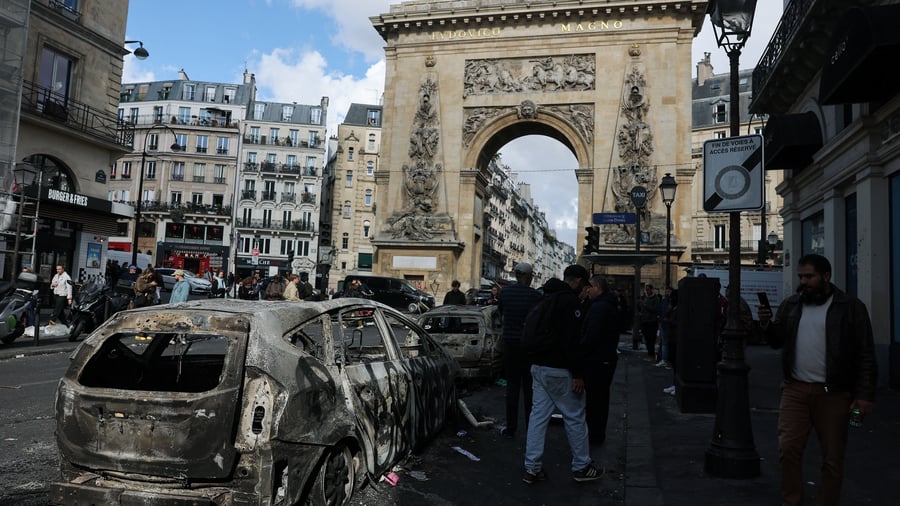
In France, unrest has given rise to growing fear of widespread chaos, known as "surface fire." Paris remains scarred by destruction: shops smashed and looted, rubbish strewn across the streets. Cleanup crews are working around the clock. On Saturday, up to a hundred thousand peaceful demonstrators first took to the streets. Then the situation spiraled out of control in many cities, especially Paris.
Paris Mayor Emmanuel Grégoire described it as a "systematic destruction" in certain areas. Protesters stood face-to-face with heavily armed riot police in the heart of the city. On the main avenues in the east, around Place de la République, groups of violent youths clashed with heavily armed police. Fires broke out on entire neighborhoods, doused by a mixture of tear gas and smoke.
Interior Minister Laurent Nuñez spoke of "riots of unprecedented scale." Five hundred police officers were injured, and around 1,800 people were arrested. Other cities were not spared: the historic town hall in Limoges, a protected monument, largely burned down; in Marseille, rioters entered the town hall. Overall, 1,500 shops were destroyed, according to the French Chamber of Commerce.
Demonstrators were also hurt. In Saint-Étienne, a young protester lost his hand to a police grenade. The protests have been ongoing for three weeks, as students and young people took to the streets demanding better learning conditions and tackling high living costs. Interior Minister Nuñez counted 550,000 demonstrators. However, among them were violent groups.
Prime Minister Sébastien Lecornu blamed the extreme left for the unrest, criticizing "groups of rioters, often hundreds, sometimes even thousands, who were clearly orchestrated by the extreme left." President Emmanuel Macron condemned violence on his platform X, stating, "In our Republic, there is no room for violence." The aftermath has sparked a power struggle between political factions, each blaming the other for the escalation.
Right-wing National Rally candidate Marine Le Pen accused left-wing presidential candidate Jean-Luc Mélenchon of directly instigating the violence. Mélenchon countered that police violence was responsible for some of the unrest. Meanwhile, U.S. Vice President J.D. Vance weighed in on X, blaming flawed immigration policies for the unrest.
Concerns about the protests' potential expansion have been raised. The far-left party La France Insoumise (LFI) has been accused of politicizing student protests and inciting confrontation with police. Some extreme left representatives openly criticized police interventions as systematic repression. Recently, there were concerns about the Yellow Vest movement flaring up again.
In France, fuel tax hikes in 2018 sparked the Yellow Vest protests. Opinion researcher Frédéric Dabi from the Ifop institute warned on Sunday of a "surface fire," citing dissatisfaction with the presidential election options and the lack of candidates promising real change. A survey showed 80 percent of respondents pessimistic about the future.
The unrest is also putting pressure on President Macron and his government. With six months left until the presidential election, they can only introduce limited reforms to calm the situation.
Written by urgent.news from Handelsblatt's reporting — not their text. Machine-written — may contain errors; check the original before relying on it.
Also reported by 1 other outlet
- After the riots: 1,800 arrests at protests in France handelsblatt.com