Disinvestment: Five Years Of Promises, Three Sales
Five years ago, the union budget announced its most ambitious privatisation programme to date. The government would keep a bare minimum presence in four strategic sectors and exit everything else. Five years later, the privatisation has resulted in the sale of Air India and Neelachal Ispat, and this week's approval of the sale of IDBI Bank. While the government will present it as proof of its…
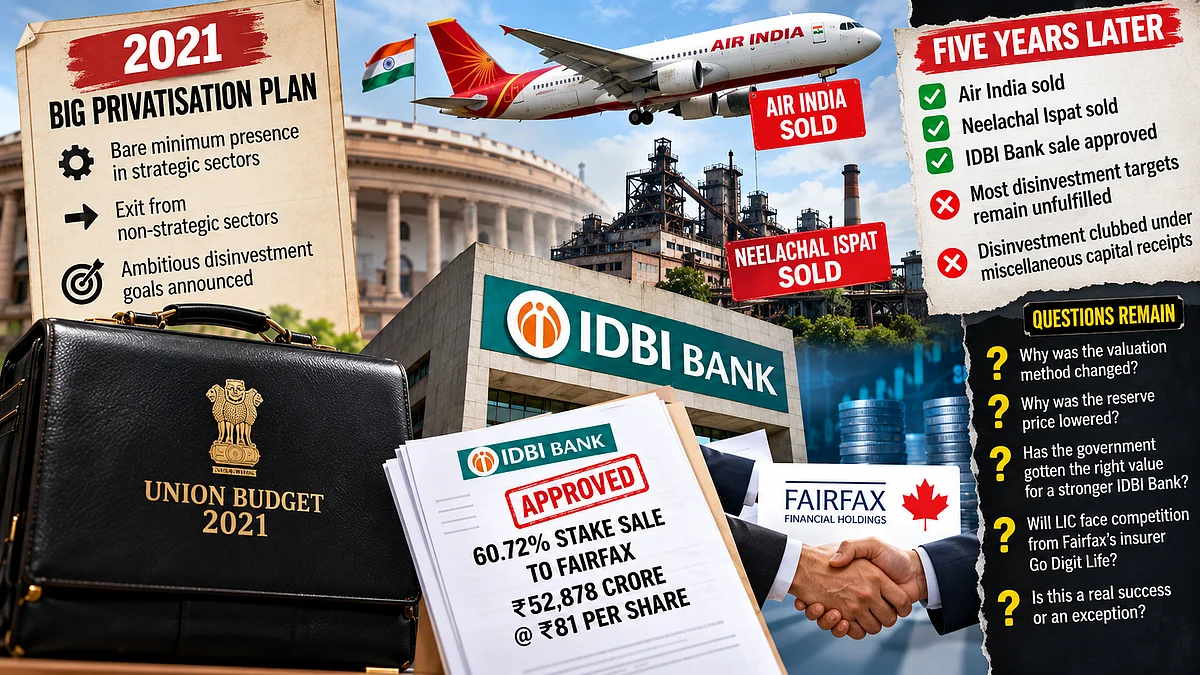
Five years ago, the Indian government unveiled its most ambitious privatisation programme to date, promising to gradually disinvest its stake in four strategic sectors. Today, the disinvestment drive has yielded the sale of Air India and Neelachal Ispat, and recently, the approval of IDBI Bank's sale to Canadian investor Fairfax Financial Holdings. However, critics argue that these achievements are exceptions rather than the rule, and that the government's disinvestment strategy falls short of its 2021 promises.
Despite the government's claims of success, the reality is that the entities targeted for sale have largely remained unchanged, as the state continues to collect dividends and lease assets. This self-serving model contrasts sharply with the government's lofty 2021 announcements. Moreover, the government has cleverly adjusted its books to accommodate the current situation, eliminating a dedicated disinvestment line item in the budget and folding it into a general category of "miscellaneous capital receipts."
The recent IDBI Bank sale to Fairfax Financial Holdings serves as a case in point. After five years, multiple rounds of bidding, and the rejection of bids that fell below the reserve price, the government ultimately approved a sale of a 60.72% stake for ₹52,878 crore (or ₹81 per share). However, this deal is not yet finalized, pending approval from the Reserve Bank of India to ensure Fairfax is fit and proper.
Notably, the sale took place at a price below the initial reserve of ₹94.42 per share, which was derived from two valuation agencies arriving at a benchmark price of ₹75.99 per share – lower than Fairfax's proposed ₹81 per share.
Critics question the government's decision to employ a different valuation method between the initial round and the final approval, arguing that the lowered valuation may have influenced the buyer's decision. Additionally, the fact that IDBI has shown significant financial improvement in the five-year period following its listing for sale is worth considering.
With a net profit of ₹9,513 crore in 2025-26, compared to around ₹1,359 crore in 2020-21, the reserve price should have been higher than the final agreed-upon amount.
Furthermore, the government's decision to retain a stake in the bank through the Public Investment Corporation (LIC) raises questions about potential competition with Fairfax's own insurer, Go Digit Life. Fairfax plans to fold Go Digit Life into IDBI through the same banking channel, potentially creating a conflict of interest. These issues suggest that while the government can push ahead with disinvestment when it wishes to, delays and complications can undermine the intended benefits.
Written by urgent.news from Free Press Journal's reporting — not their text. Machine-written — may contain errors; check the original before relying on it.