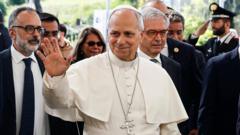
Pope's health should not be taken 'for granted', says top Vatican diplomat
Archbishop Paul Gallagher tells the BBC there was no sign of the Pope's ill health prior to his operation this week.
A telling story from Pope John Paul II's papacy reveals how Pope Leo XIV, an American pope, transformed the Vatican's governance and health crisis management. When John Paul II, 84 years old, was admitted to Gemelli hospital suffering from an acute respiratory infection, breathing difficulties, and Parkinson's disease-related complications, a supposedly candid update from his spokesman claimed he had consumed his usual breakfast despite severe medical issues.
This was typical for the era when lies about the pope were the norm. Twenty years later, Pope Leo XIV altered this approach. Not only did he openly announce his lung nodule surgery during his Sunday noon blessing, but his medical updates were now provided by his personal physician, Dr. Luigi Carbone, and the head of thoracic surgery at Gemelli, Dr. Stefano Margaritora, rather than the Vatican spokesman.
This shift towards transparency and accountability mirrors American-style corporate governance. Julia Rubio, a professor of Christian social ethics, notes that Leo's American background, including his passion for mathematics, influenced his governance style, including his inclusive presentation of an encyclical on artificial intelligence.
He invited cardinals, lay female theologians, and an AI developer to speak on various perspectives, reflecting the church's growing inclusiveness. This approach, initiated by Pope Francis, makes the church more reflective of the real world. However, Leo's transformation was gradual, and the process is still unfolding. While Francis governed independently, rejecting medical advice and often declining surgical options, Leo embraced medical expertise, reflecting the change in governance practices.
Written by urgent.news from Winnipeg Free Press's reporting — not their text. Machine-written — may contain errors; check the original before relying on it.
This story
This is one outlet's version. Read the fullest account.
- An American pope brings American-style governance to the Vatican, even in a health crisis winnipegfreepress.com
- An American Pope Brings American-Style Governance to the Vatican, Even in a Health Crisis japannews.yomiuri.co.jp
- Pope Leo XIV brings American-style governance to the Vatican, even in health crisis koreatimes.co.kr
- Pope's health should not be taken 'for granted', says top Vatican diplomat bbc.co.uk