EuroCham confidence index holds at 78 3 despite operational hurdles
European companies in Vietnam remain confident in the market despite global economic uncertainties with the European Chamber of Commerce s Business Confidence Index holding strong at 78 3 in the third quarter of 2026
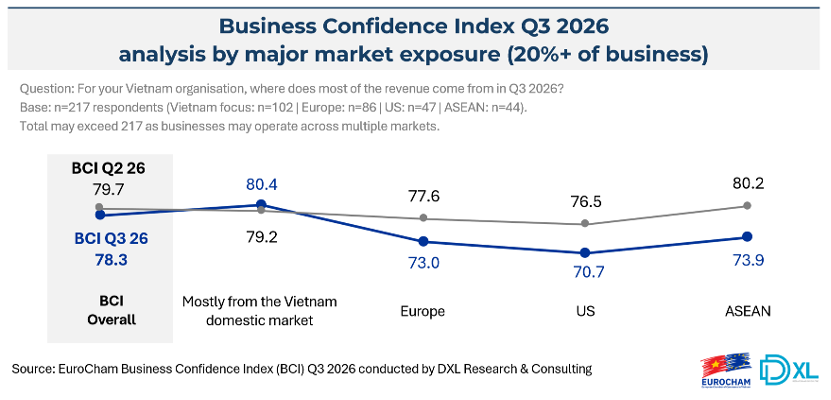
The European Chamber of Commerce in Vietnam (EuroCham) released its Business Confidence Index (BCI) on October 15, maintaining a high reading of 78.3 despite the presence of operational challenges. Conducted by DXL Research and Consulting, the Q3 BCI report revealed that 93% of respondents faced regulatory and administrative issues, while an equal proportion encountered tax and financial administration hurdles. The BCI dipped by 1.4 points from 79.7 in the previous quarter, indicating a moderate decrease.
The BCI's stability is reflected in 64% of respondents describing their business situation as good or very good. However, 28% of businesses exhibited a wait-and-see attitude, anticipating that international demand would plateau and seeking faster procedures and more predictable outcomes. Sector analysis highlighted varying strengths and weaknesses: the agriculture and food value chain experienced the most significant improvement, rising to 83.9, despite challenges in input costs and competition from regional imports.
Vietnam's role in regional production and cross-border commerce contributed to the strength of trade, logistics, and consumer goods sectors.
Conversely, tourism and hospitality sectors declined by 22.5 points to 67.9 following a strong previous quarter, reflecting the sensitivity of consumer-facing businesses to changes in spending patterns, operating costs, and external disruptions, including recent extreme weather. Market exposure also influenced confidence levels, with businesses focused on Vietnam scoring 80.4, compared to 73.2 for EU-focused firms, 70.7 for US-focused firms, and 73.9 for ASEAN-focused firms.
EuroCham Chairman Bruno Jaspaert emphasized Vietnam's impressive economic performance, with GDP growing by 9.95% on-year in Q3 and 9.01% over the first nine months. However, he cautioned that these figures do not fully capture the challenges businesses face, such as rising raw material and labor costs, sourcing ground re-engineering, and varied impacts on businesses operating in different markets.
Despite these challenges, nine out of ten respondents recommended Vietnam as an investment destination, with 63% planning operations for more than five years, and 23% looking beyond a 20-year horizon.
Vietnam's appeal is attributed to its human capital, cost competitiveness, political and macroeconomic stability, domestic market, large network of free trade agreements, and strategic position amid shifting global supply chains. Sustainability is gaining prominence as an investment consideration, particularly among large enterprises. As businesses reassess supply chains due to global tensions and changing trade relationships, Vietnam is emerging as a strategic hub connecting regional growth with global markets.
Written by urgent.news from Vietnam Investment Review's reporting — not their text. Machine-written — may contain errors; check the original before relying on it.