Crew Unpacks Dragon and Begins Activating New Science Experiments
Five spacecraft are docked at the International Space Station following the arrival of a cargo-packed SpaceX Dragon on Thursday. The Expedition 75 crew members have begun unloading Dragon and are activating new science experiments to benefit life on and off the Earth. The post Crew Unpacks Dragon and Begins Activating New Science Experiments appeared first on NASA Science .
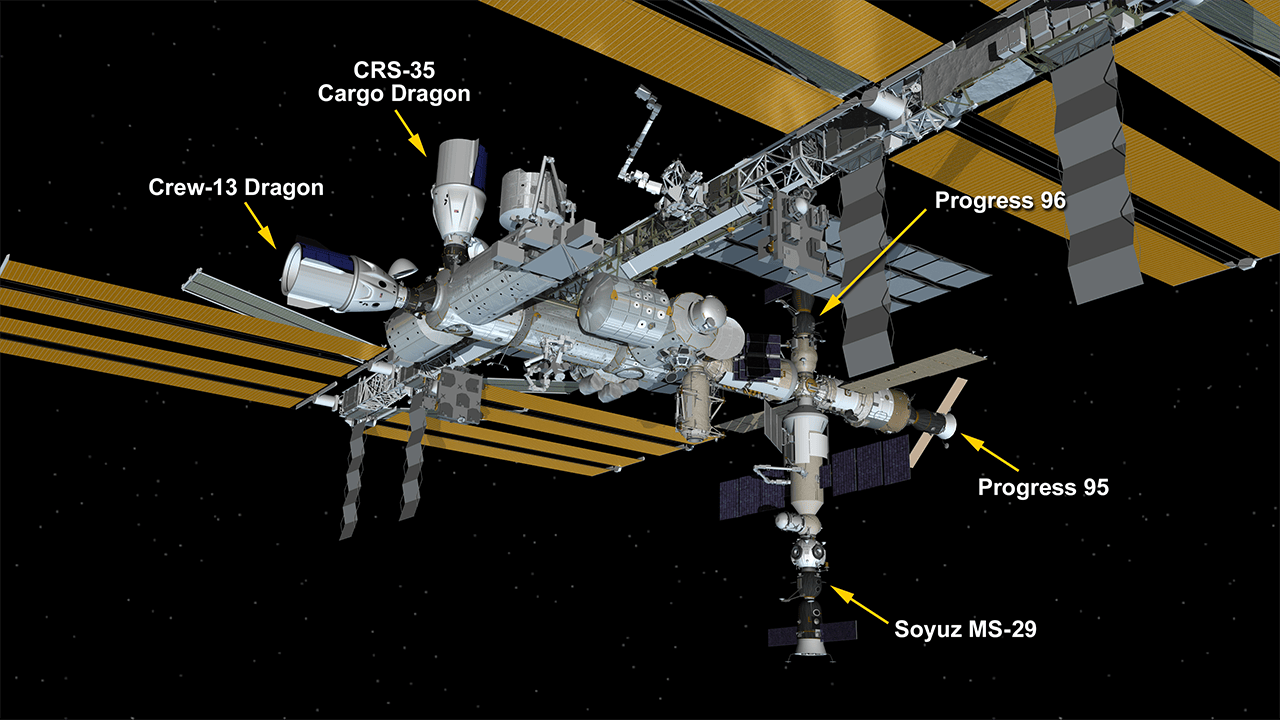
On October 15, 2026, the International Space Station welcomed a new arrival: SpaceX's CRS-35 and Crew-13 Dragon spacecraft. The five spacecraft currently docked at the ISS included the Soyuz MS-29 crew spacecraft, the Progress 95 and 96 resupply ships, and the freshly docked Dragon.
Eager to begin their scientific endeavors, Expedition 75 crew members launched into action, unloading the Dragon and initiating a series of fresh experiments. These investigations aimed to enhance life on Earth as well as in space, focusing on artificial retinas, heart tissue growth in microgravity, protein crystal formation for cancer treatments, and the genetic response of plants to microgravity conditions.
The crew also worked on augmenting the space station's power generation system with roll-out solar arrays, which were carefully installed inside Dragon's unpressurized trunk. Engineers will eventually retrieve these arrays using the Canadarm2 robotic arm and mount them on the station's truss structure, boosting the station's energy output.
Simultaneously, crew members engaged in virtual reality studies, assessing the potential of an exoskeleton suit for remote robotics operations on future long-term space missions. The suit, paired with virtual reality goggles and hand controls, allowed crew members to manipulate tools in a simulated space environment, providing valuable insights into adapting to weightlessness.
Throughout the week, Roscosmos' flight engineer Sergey Teteryatnikov participated in additional virtual reality experiments, honing his sense of balance and orientation in microgravity. He also inspected hydraulics components and serviced the Elektron oxygen generator before concluding his duties.
Written by urgent.news from NASA Science's reporting — not their text. Machine-written — may contain errors; check the original before relying on it.