The Cost of Living and Wages
Here are several price indicators for consumers: Figure 1: CPI – all urban (black), CPI wage earners and clerical workers (purple), chained CPI (light green), CPI ex-shelter (blue), AIER Everyday Price Index (red), all in logs 2025M01=0. Source: BLS, AIER, ad author’s calculations. If you feel like everyday expenses are rising faster than the CPI […]
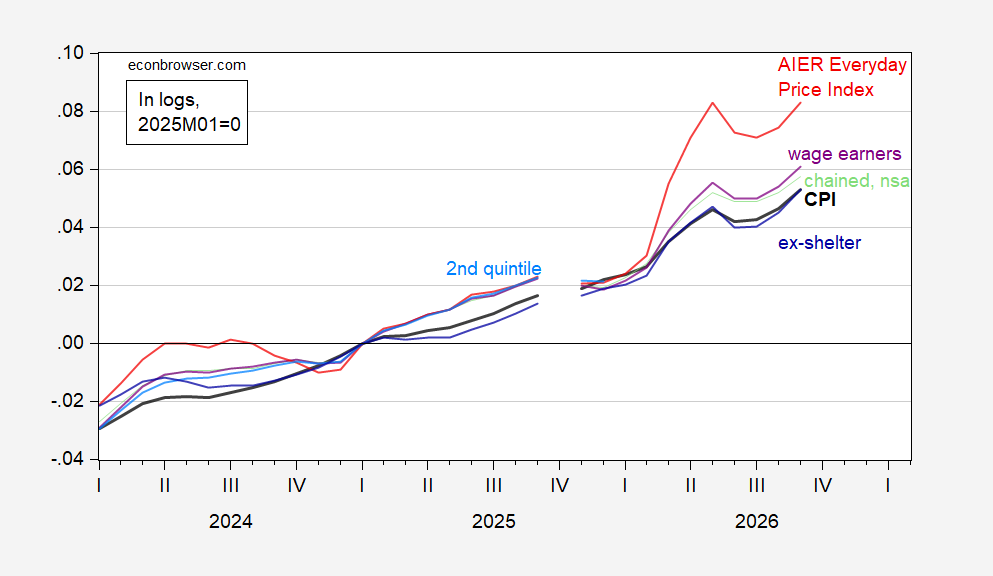
Recent data from the Bureau of Labor Statistics (BLS) and the Average Incomes & Everyday Prices (AIER) institute reveal that the cost of living is outpacing wage growth in the United States. According to a chart, the Consumer Price Index (CPI) for all urban residents (black) and the CPI for wage earners and clerical workers (purple) have been rising steadily. The chained CPI (light green) and the CPI excluding shelter expenses (blue) also show an upward trend, with the AIER Everyday Price Index (red) closely following.
However, the divergence becomes more pronounced when comparing wage growth to the cost of living. Figure 2 illustrates the average hourly earnings for production and nonsupervisory workers, deflated by different CPI indices. The data suggests that real hourly earnings are significantly lagging behind the rate of inflation, particularly when using the AIER Everyday Price Index (red) as the deflator. This discrepancy indicates that workers' purchasing power is eroding at an alarming rate.
Adding to these concerns, the Final Demand Producer Price Index (PPI) has been surging at a much faster pace than the CPI. As depicted in Figure 3, the final demand PPI (red) is growing exponentially compared to the CPI (blue), both expressed in logarithmic terms. The surge in the PPI is primarily driven by "fuels and related products," suggesting that the upward pressure on overall prices is likely to continue.
In light of these findings, it appears that the cost of living in the United States is accelerating beyond the rate of wage increases. This wage-price disconnect could lead to a decline in consumer spending power, potentially impacting economic growth in the coming months.
Written by urgent.news from Econbrowser's reporting — not their text. Machine-written — may contain errors; check the original before relying on it.