The AISHE Report: Institutional Network Of Higher Education
Higher education plays a crucial role in bridging the gap between formal education and the labour market in a society. It also plays an important role in an individual’s intellectual growth. Yet, before the All India Survey on Higher Education (AISHE) reports, there was no systematic collection of data covering the entire range of higher education institutions in the country. As the need for a…
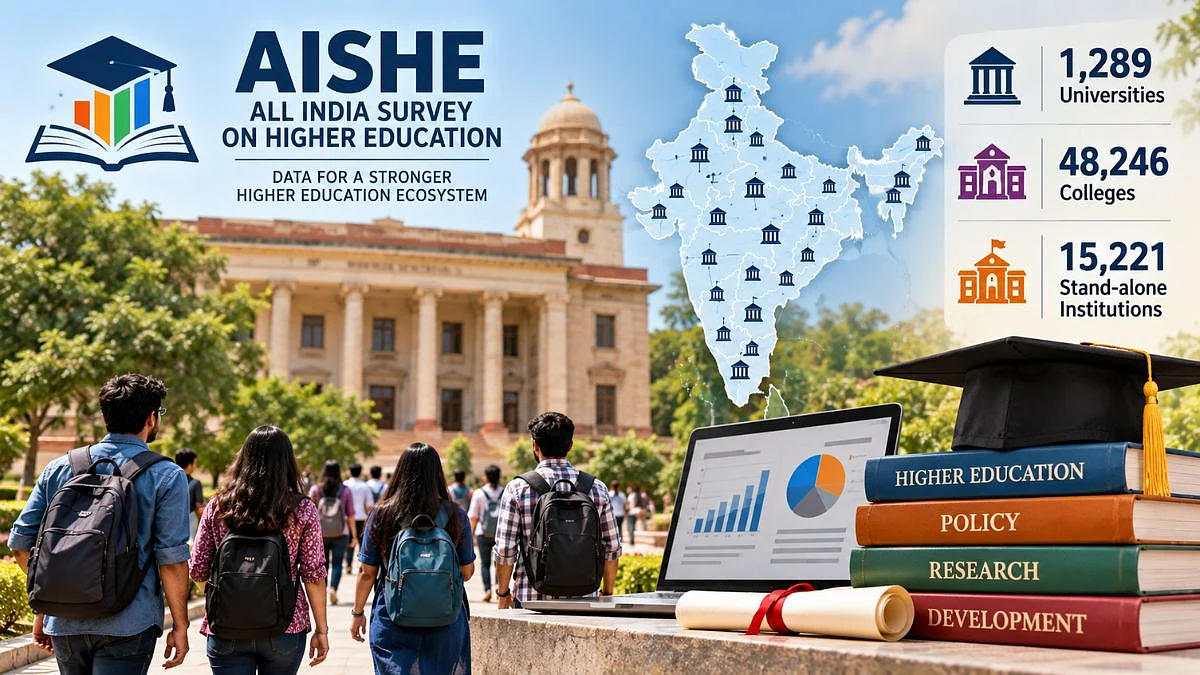
The All India Survey on Higher Education (AISHE) report provides a comprehensive overview of the higher education landscape in India. The report covers the year 2023-24 and includes data on universities, colleges, and stand-alone institutions across the country. Key findings include:
Universities and colleges: There are a total of 1,289 universities, 48,246 colleges, and 15,221 stand-alone institutions registered in the 2023-24 survey. Of these, 1,278 universities, 46,468 colleges, and 11,787 stand-alone institutions submitted their data to the AISHE portal. The data highlights the distribution of universities and colleges across different states and union territories.
Types of institutions: Almost 60% of universities are general or multidisciplinary, while 13.5% are technical, 7.7% are medical, and 4.1% are agricultural. There are also 37 minority-run universities and 18 universities exclusively for women. Among colleges, 15,901 offer postgraduate programs, with the majority being private unaided institutions.
Stand-alone institutions: Stand-alone institutions cater to specialized courses such as diploma programs in technical, teacher training, nursing, management, and other disciplines. These institutions are primarily privately owned and managed, with a significant proportion being government-funded.
Geographic distribution: The concentration of colleges varies across districts, with some districts accounting for a large percentage of the total. The highest number of colleges is found in the districts of Bengaluru Urban, Jaipur, Pune, and Hyderabad. Conversely, several districts have fewer than 10 colleges each, with an average college density of 32 colleges per lakh of eligible population aged 18-23 years.
Financial aspects: The report does not provide detailed financial information but notes that participation by higher education institutions in the survey is voluntary, with responsibility for data accuracy resting with the institutions themselves. The Department of Higher Education verifies the data to the extent possible.
This summary provides an overview of the institutional network of higher education in India, highlighting the key aspects of universities, colleges, and stand-alone institutions, as well as their geographic distribution and characteristics.
Rewritten by urgent.news; may contain errors — check the original.
Source: freepressjournal.in