Planetary systems fall into 2 distinct families, astronomers say
Astronomers studying planetary systems in the Milky Way have found they can be sorted into 2 families. These families are largely determined by the host star. The post Planetary systems fall into 2 distinct families, astronomers say first appeared on EarthSky .
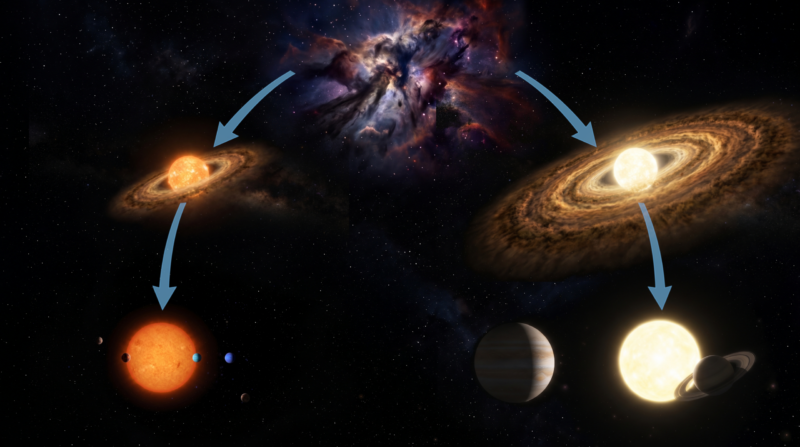
Astronomers have discovered that planets in our Milky Way galaxy tend to organize into two distinct families, based on the characteristics of their home stars. After examining 300 of the best-understood planetary systems, researchers identified two clear types of planetary systems. The first type is characterized by a less massive star with smaller, closely packed planets. In contrast, the second type features a more massive star surrounded by a wider, more distant planetary system with larger, fewer planets.
The researchers attribute these differences to the amount of material present in the cloud of gas and dust that forms the star. A star with more material tends to create a wider and more chaotic system, while a star with less material produces a compact and orderly system. The compact planetary systems are composed of smaller, more similar planets that orbit closer to their star. In contrast, the wider planetary systems consist of larger, more varied planets that orbit further away from their star.
The study, published in the journal Nature Astronomy, suggests that the type of planetary system a star forms is determined not just by its evolution over time, but also by its initial conditions. This could help in the search for planets that may support life, as understanding the mechanisms behind these two distinct families of planetary systems could inform future explorations.
Written by urgent.news from EarthSky's reporting — not their text. Machine-written — may contain errors; check the original before relying on it.