Studying beautiful flavour transitions
Studying rare processes is part and parcel of particle physics, providing stringent tests of the Standard Model. At the recent International Conference on High Energy Physics (ICHEP), the CMS and LHCb Collaborations presented their latest research into one such process: the transformation of a beauty quark into a strange quark, a muon and the oppositely charged antimuon (b→sμ+μ–). Flavour…
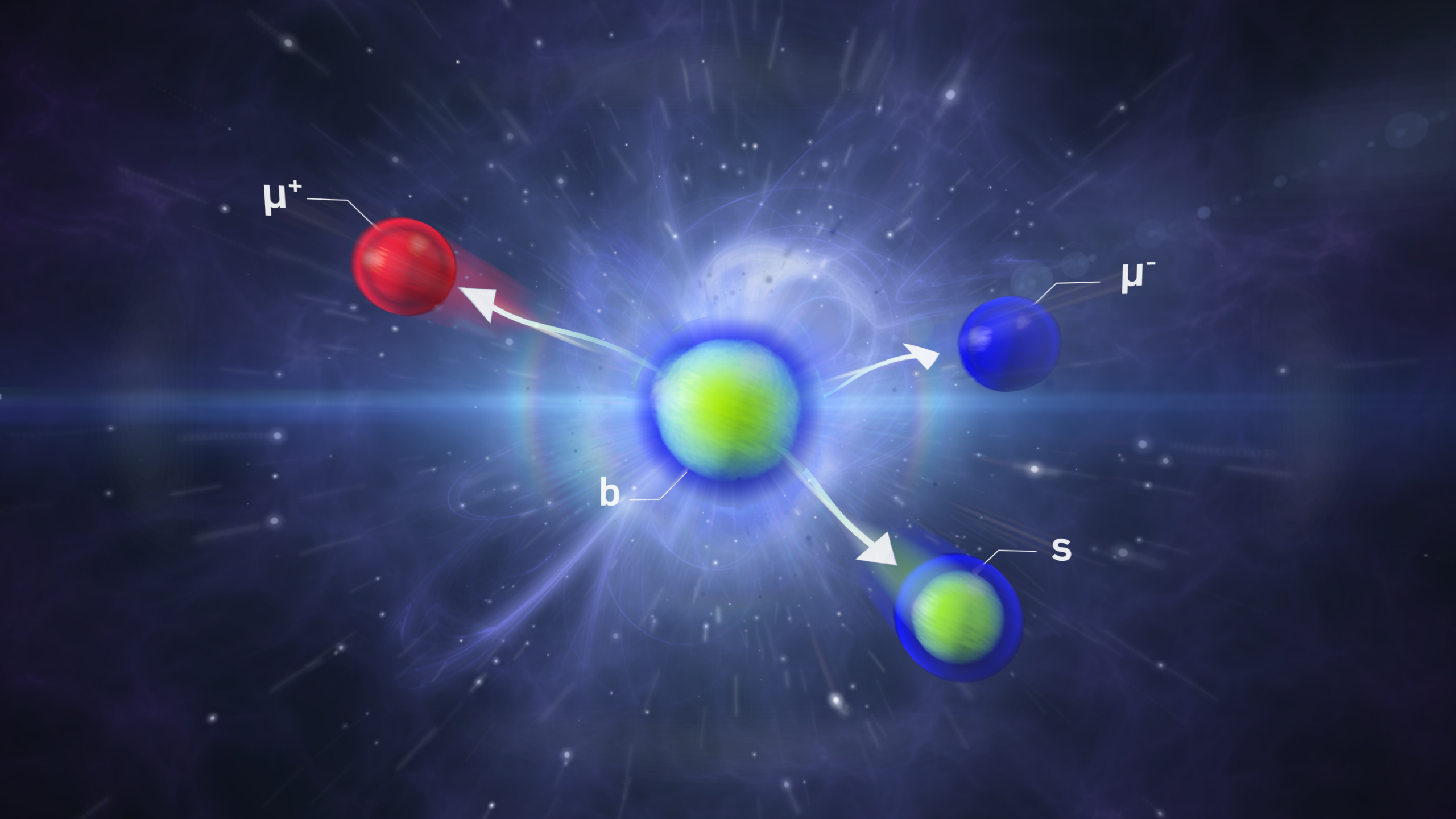
Particle physicists have released fresh findings on the uncommon shift of a heavy quark into a lighter one accompanied by two muons. Conducted by researchers from the Compact Muon Solenoid (CMS) and LHCb collaborations, these results were unveiled at the International Conference on High Energy Physics (ICHEP).
The study focuses on the b→sμ + μ – transition, where a beauty quark metamorphoses into a strange quark, a muon and an antimuon. Such flavor transitions, changes between types of quarks, can only occur via the weak interaction, one of the four fundamental forces of nature. Quantum physics dictates that other particles not directly involved in a specific transition can influence how that transition unfolds.
If a process deviates from predictions based on the known particles, as described by the Standard Model, the discrepancy could signal the existence of unknown particles or interactions. The b→sμ + μ – transition is particularly intriguing as it's highly rare, occurring roughly once in every ten million decays of beauty particles.
Over the past ten years, there have been subtle hints that this transition may not occur as anticipated. To probe this further, CMS and LHCb analyzed decays of beauty particles into those containing strange quarks along with muons and antimuons. They examined six types of these decays, each with its own branching fraction - a measure of the likelihood of a particular decay occurring.
Interestingly, while the differences between predicted and measured branching fractions for each decay type were minuscule, they were consistent across all six types. This consistency was achieved through a simultaneous analysis of all decay types, which allowed for consistent treatment of background signals and data uncertainties.
Additionally, CMS utilized data from the third and final run of the Large Hadron Collider (LHC), which enabled them to measure branching fractions with unprecedented precision. On the other hand, LHCb analyzed one of the six decay types - the transformation of a neutral beauty meson into an excited kaon (B 0 →K*μ + μ – ) - using a new model-independent analysis method. This technique did not rely on theoretical assumptions about the decay process itself.
The model-independent measurement by LHCb indicated a slight deviation from the Standard Model prediction. This small difference, while not conclusive, has motivated further investigation into the b→sμ + μ – transition. With ongoing advancements in measuring rare processes, hints of undiscovered particles or interactions may eventually become clearer.
Written by urgent.news from CERN's reporting — not their text. Machine-written — may contain errors; check the original before relying on it.