Patchier Permafrost Is Linked to More Intense Hillslope Erosion
Arctic landscapes with spots of disconnected permafrost erode faster than those with continuous permafrost, a new study finds.
The Arctic is warming four times faster than the global average, prompting scientists to investigate how this rapid warming impacts the region's landscapes and ecosystems. One of the most noticeable effects of climate change in the Arctic is the thawing of permafrost, leading to the collapse of hillslopes and coastal erosion. This disruption of ecosystems, release of carbon, and threat to Indigenous communities has led researchers to study the differences in erosion between continuous and discontinuous permafrost landscapes.
Continuous permafrost covers landscapes where the ground is frozen year-round, while discontinuous permafrost consists of areas where only 50% to 90% of the terrain is underlain by permafrost. Özpolat et al. aimed to examine the differences in how these two types of landscapes erode, focusing on two primary erosion processes: diffusive processes, which mainly move sediments on hillslopes, and advective processes, which primarily erode and transport sediments in channels.
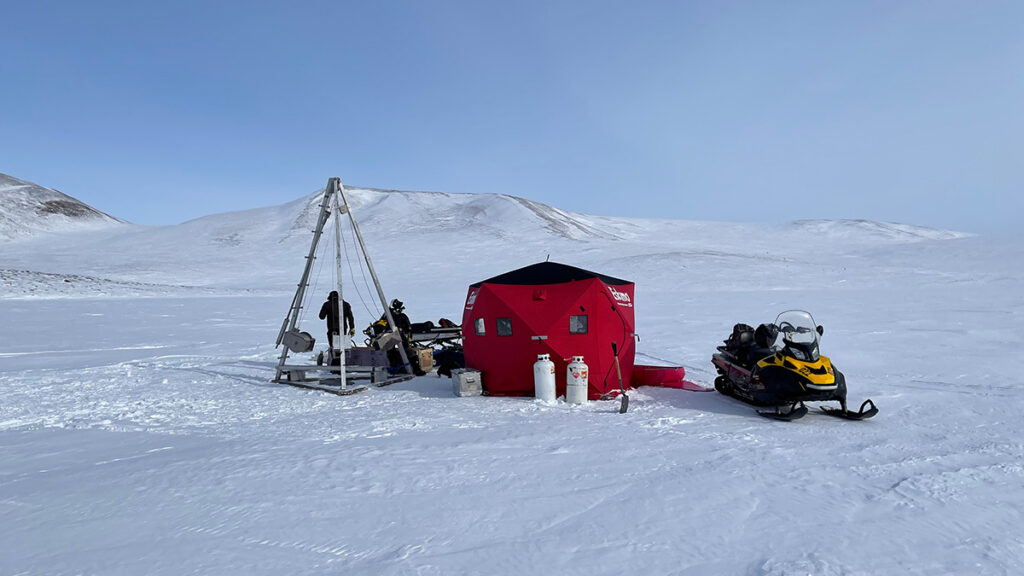
While these processes are crucial for shaping landscapes, their relative magnitudes have not been well understood in permafrost regions, with most models estimating their contributions rather than basing them on direct catchment-scale observations. To better understand these processes, the researchers collected sediment cores from 12 lakes in Alaska—one near Toolik, which has more continuous permafrost, and another near Delta Junction, which has more discontinuous permafrost.
These cores spanned the middle Holocene to the present, capturing a period when climate and permafrost conditions were similar to their current state. By analyzing these cores, the researchers calculated sediment fluxes and erosion rates in the lakes' catchments, which they used to determine the relative importance of diffusive and advective components in a landscape evolution model.
The findings revealed that in both study areas, diffusive processes, primarily occurring on hillslopes, were more significant than advective processes, indicating that these diffuse erosional processes have been more influential in shaping the landscape since the middle Holocene. Crucially, in areas with discontinuous permafrost, the average intensity of diffusive erosion was 2 to 3 times greater than in areas with continuous permafrost.
While the authors caution that these intensity differences may be specific to the study sites and recommend further research in other catchments, their results suggest that as warming shifts some landscapes from continuous to discontinuous permafrost conditions, hillslope erosion could increase significantly.
Written by urgent.news from Eos's reporting — not their text. Machine-written — may contain errors; check the original before relying on it.