NASA’s Chandra Breaks Down ‘Treble Clef’s’ Galaxy Cluster Collision
Astronomers have used NASA’s Chandra X-ray Observatory to break down the cause of a remarkable formation of radio waves they have nicknamed the “Treble Clef” because its distinct shape strongly resembles the musical symbol. The researchers discovered the Treble Clef is likely caused by an outburst from a supermassive black hole, followed by a collision […]
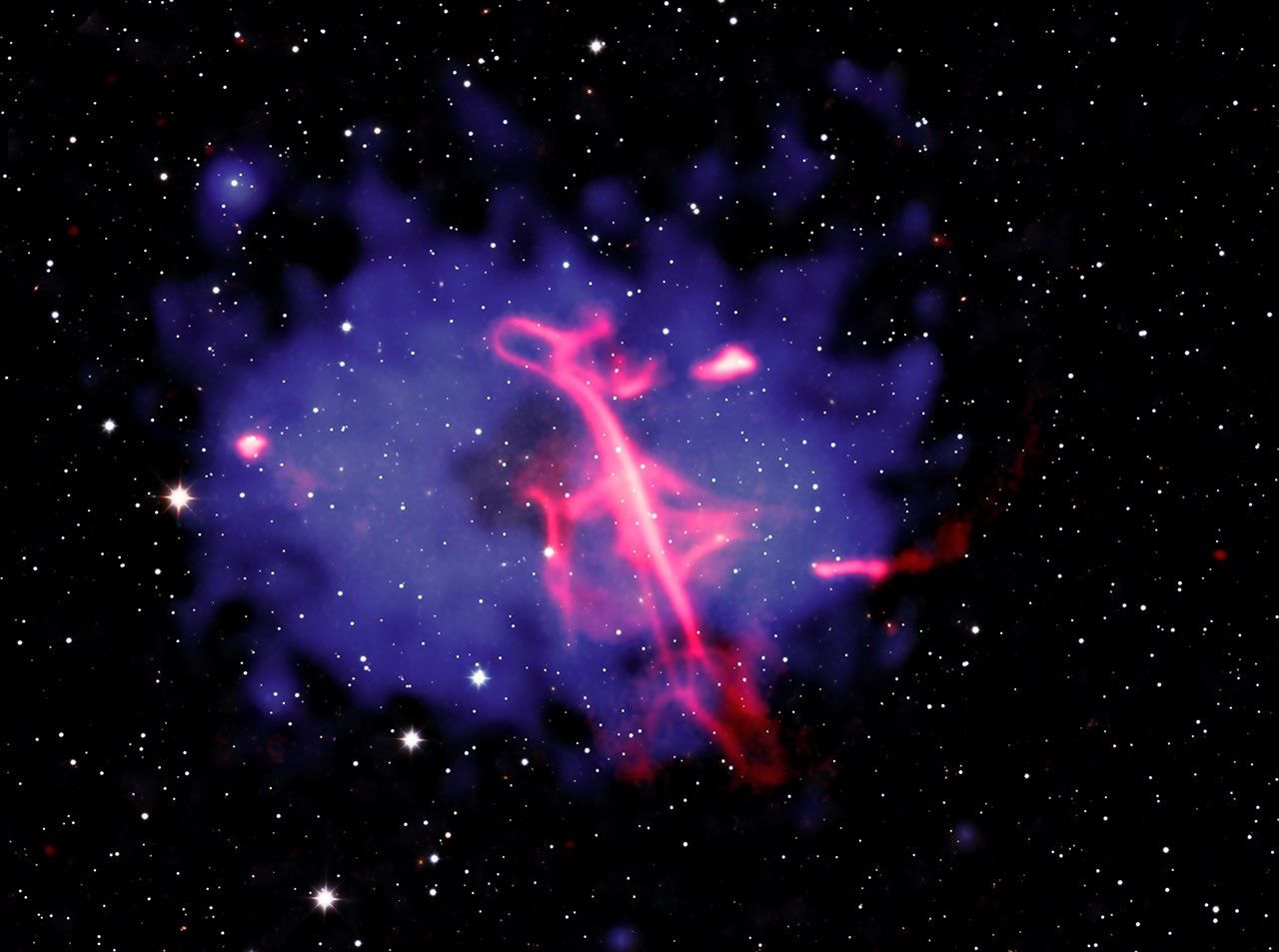
NASA's Chandra X-ray Observatory has unravelled the mystery behind the formation of a radio wave structure in a galaxy cluster, aptly named the "Treble Clef." The distinctive shape bears a striking resemblance to the musical symbol, leading astronomers to nickname it as such. The research team, led by Andrea Botteon of the National Institute for Astrophysics in Italy, published their findings in the Astronomy & Astrophysics journal.
The challenge in identifying the cause of the Treble Clef's formation lies in its location almost directly behind the plane of the Milky Way, making it difficult for Earth-based telescopes to observe due to the obstruction of stars, gas, and dust. To overcome this, the team utilized Chandra and the eROSITA X-ray telescope to detect diffuse, hot gas at the location of the Treble Clef, confirming the presence of a galaxy cluster.
Further analysis revealed that the galaxy cluster is actually the result of two clusters merging. Chandra and the Extended RÖntgen Survey with an Imaging Telescope Array (eROSITA) X-ray telescope captured diffuse, hot gas at the Treble Clef's location, indicating the presence of a galaxy cluster. The collaboration of Chandra and the LOw Frequency ARray (LOFAR) led to the discovery of the Treble Clef's shape, with LOFAR's radio data depicted in red.
The Treble Clef formation is believed to have occurred in a two-stage process. Initially, an outburst from a supermassive black hole in the galaxy cluster's center drove charged particles and magnetic fields away at near-light speeds, producing bright radio waves that later faded as the particles lost energy. Subsequently, the collision between the two clusters reenergized the cloud, causing it to become brighter again in radio waves.
Shock waves generated during the collision may have played a crucial role in this reenergization process.
By employing a special technique to examine the deviation of the cluster's hot gas from a symmetrical shape, the researchers identified evidence supporting the cluster collision. The Chandra data, when processed, revealed that the brightest X-rays were located on the left and right of the cluster's center, with the center being the faintest.
Combining the original X-ray and residual X-ray images yielded a composite image that showcased the Treble Clef-like formation hidden behind the two colliding galaxy clusters. The direct collision between the clusters is estimated to have taken place a few hundred million years ago, and the clusters are now moving apart from each other.
However, the Treble Clef's resemblance to a musical notation is purely coincidental, as there is no scientific connection between the two.
Written by urgent.news from NASA's reporting — not their text. Machine-written — may contain errors; check the original before relying on it.
This story
This is one outlet's version. Read the fullest account.
- NASA’s Chandra Breaks Down ‘Treble Clef’s’ Galaxy Cluster Collision science.nasa.gov