NASA’s Chandra Breaks Down ‘Treble Clef’s’ Galaxy Cluster Collision
Astronomers have used NASA’s Chandra X-ray Observatory to break down the cause of a remarkable formation of radio waves they have nicknamed the “Treble Clef” because its distinct shape strongly resembles the musical symbol. The researchers discovered the Treble Clef is likely caused by an outburst from a supermassive black hole, followed by a collision […] The post NASA’s Chandra Breaks Down…
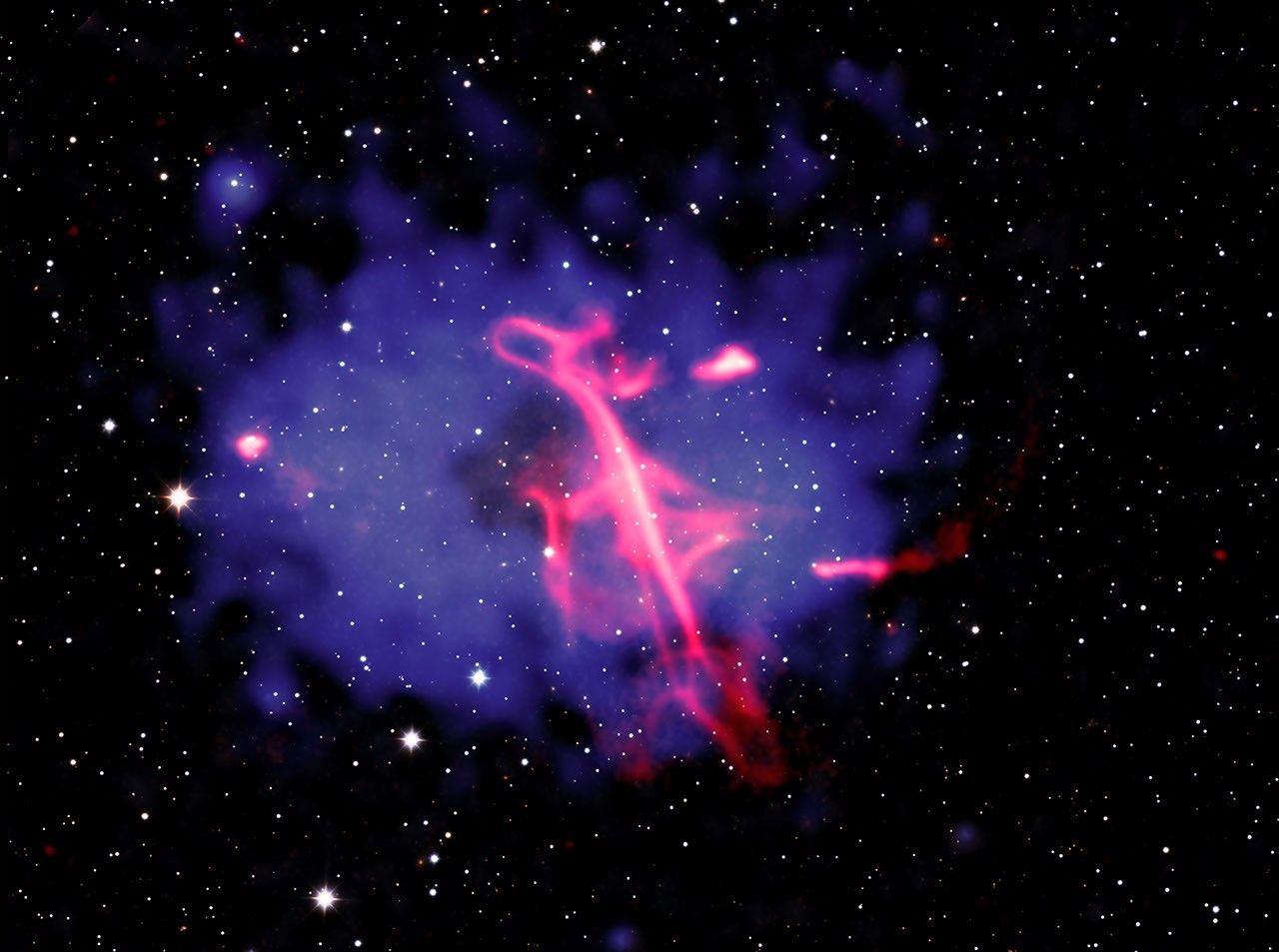
NASA’s Chandra X-ray Observatory has helped astronomers uncover the cause behind the formation of a radio wave pattern nicknamed the “Treble Clef.” The distinctive shape, which resembles a musical symbol, was discovered to be the result of a supermassive black hole outburst followed by a collision between two galaxy clusters. The research, led by Andrea Botteon of the National Institute for Astrophysics in Italy, is published in the Astronomy & Astrophysics journal.
The challenge in identifying the cause of the Treble Clef lay in its location behind the Milky Way, which blocks visibility from Earth. By utilizing telescopes capable of penetrating the intervening material, the team was able to determine that the formation is a result of a galaxy cluster experiencing a merger. The composite image created by combining Chandra X-ray, LOFAR radio, and infrared data from the United Kingdom Infrared Telescope reveals the hot gas in blue, the radio waves in red, and the infrared data in white.
The findings suggest that the Treble Clef underwent a two-stage process, starting with a supermassive black hole outburst that initially produced bright radio waves, followed by the collision of two galaxy clusters that reenergized the cloud and led to the formation of the distinctive pattern.
Brief written by urgent.news from NASA Science's own syndicated text. Machine-written — may contain errors; check the original before relying on it.
Also reported by 1 other outlet
- NASA’s Chandra Breaks Down ‘Treble Clef’s’ Galaxy Cluster Collision science.nasa.gov