Exploring a world full of minds in Los Angeles
After witnessing the horrors of World War I, the naturalist Henry Beston retreated to a tiny cabin on the dunes of Cape Cod in search of a peace that human civilization had shattered. There, watching the birds and creatures around him, he began to question humanity’s place in the natural world. In 1928, he wrote that animals “are not brethren, they are not underlings; they are other nations,…
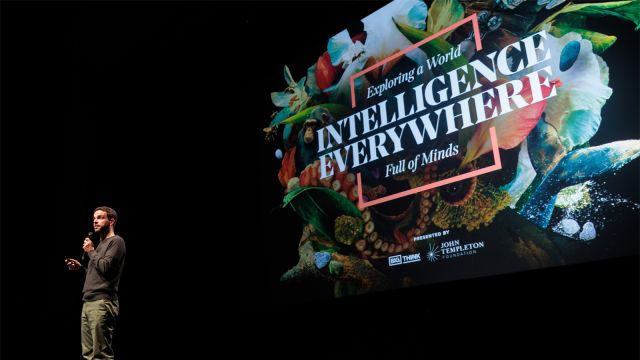
In 1928, naturalist Henry Beston penned that animals are "other nations, caught with ourselves in the net of life and time." Nearly a century later, science is uncovering the extraordinary nature of these "other nations." Birds with walnut-sized brains can outperform primates in logic puzzles. Forests communicate through intricate fungal networks.
Flocks of birds may possess knowledge that no single bird possesses. Silicon chips can reason and even write poetry. On October 3, 2026, Big Think and the John Templeton Foundation hosted a gathering in Santa Monica aimed at defining intelligence. The event, "Intelligence Everywhere: Exploring a World Full of Minds," was hosted by comedian Chris Duffy.
Diana Reiss, a professor of psychology at Hunter College, began the evening by sharing a bet she made in the 1980s. She observed that when animals are given more choice and control, they demonstrate more of their mind. She presented an example of an elephant that solved a problem that had previously confounded primates. Felicity Muth, an associate professor of animal behavior at UC Davis, tackled the question of whether bees were smarter than dogs.
She argued that the question was misguided and focused on the importance of understanding each animal's unique "Umwelt" – the world perceived through their senses and experiences. Dora Biro, a professor of brain and cognitive sciences, discussed the concept of wisdom of crowds, using examples from fairground ox estimations and migrating birds.
She concluded with three lessons for people: respect diversity of opinion, allow noise, and reward forgetting and exploring.
Athena Aktipis, a professor at Arizona State University and the director of the Cooperative Futures Institute, argued that cooperation is a form of intelligence essential for our survival. She explored the challenges of larger groups and emphasized the importance of building cooperation into AI technology. The evening concluded with a musical performance by Joe Patitucci and his device, PlantWave, which translated the electrical fluctuations in living plants into sound.
Rewritten by urgent.news; may contain errors — check the original.
Source: bigthink.com