Weirdest cloud on Mars formed via ‘exotic physics’
The weirdest cloud on Mars has a funny-sounding name. Scientists call it the Arsia Mons Elongated Cloud. Come find out what's weird about it! The post Weirdest cloud on Mars formed via ‘exotic physics’ first appeared on EarthSky .
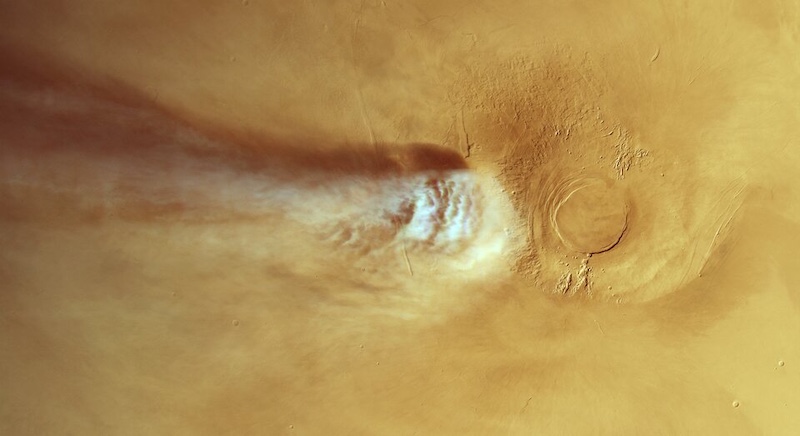
The Arsia Mons Elongated Cloud (AMEC) is a peculiar annual cloud that emanates from the Martian volcano Arsia Mons. Discovered by the European Space Agency’s Mars Express orbiter in 2018, this elongated formation can stretch up to 920 miles (1,500 km) in length, a phenomenon that has baffled scientists due to its unusual behavior and daily cycle.
Traditionally, clouds on Mars and Earth form through the cooling and condensation of water vapor onto particles like salt, pollen, soot, or dust. However, researchers from Sorbonne University in Paris, France, have discovered that the AMEC forms via a rare "exotic physics" process that has never been observed before in any planetary atmosphere. This process, known as homogeneous nucleation, involves water vapor turning directly into icy cloud particles without a middle step of condensation onto particles.
The scientists conducted new simulations that incorporated this exotic physics and found that the AMEC emerges as expected. Lead author Jorge Hernández-Bernal explained that the cloud forms without the need for "seed" particles, instead relying on water vapor freezing directly into cloud particles. This phenomenon requires exceptional circumstances, including extremely high relative humidity levels of over 100,000 times those found on Earth.
The formation of the AMEC is triggered by the interaction of winds with the towering volcanic structure of Arsia Mons. As winds flow past the volcano, they cause a powerful wave that lifts moist air parcels into the atmosphere within minutes, leading to rapid cooling and a sharp spike in relative humidity. This triggers the spontaneous freezing of water vapor into cloud particles, resulting in the elongated cloud formation.
While the new model doesn't perfectly match the Mars Express observations, the researchers believe that their findings are still a significant success. The complexity of Mars’ atmosphere makes it challenging to replicate phenomena as accurately as on Earth. Nevertheless, the discovery of the AMEC and its unique formation process provides valuable insights into the atmospheric conditions on Mars and the potential for previously unseen physical processes in planetary atmospheres.
Written by urgent.news from EarthSky's reporting — not their text. Machine-written — may contain errors; check the original before relying on it.