The ‘Zuck has entered the building … Meta says its new AI models on par with OpenAI, Anthropic
Meta unveils its new AI models, Wonder and Wonder Full, claiming they rival OpenAI’s ChatGPT and Anthropic’s Claude, as part of its strategic push to compete in the AI landscape with significant investments and a focus on safety and security.
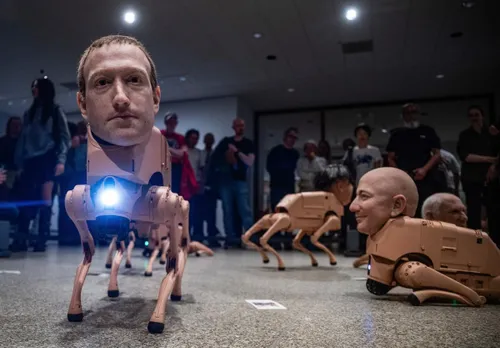
Meta announced on Monday the release of two groundbreaking artificial intelligence models, Wonder and Wonder Full, asserting their performance rivals those of OpenAI's ChatGPT and Anthropic's Claude. CEO Mark Zuckerberg declared on X that these new models, part of Meta's Muse family, represent a significant leap forward in the field of AI.
Zuckerberg's push for Meta to compete with industry leaders intensified in recent years, driven by a desire to diversify revenue beyond advertising and to stay ahead in the AI race. In June 2025, Meta invested $14 billion in Scale AI and hired its co-founder Alexandr Wang, now Meta's chief AI officer, to lead the Superintelligence Labs division.
Unlike Meta's previous open-source model, Llama, the new Wonder and Wonder Full models are tailored for commercial use, initially available through Meta's Muse app for paid subscribers. Wang praised Wonder, stating it is "our largest and most capable model yet" and "rivals the big boys," referring to OpenAI and Anthropic.
Meta's benchmarking data, provided by an independent firm, suggests that Wonder outperforms its previous models, Spark, as well as models from Anthropic, OpenAI, and Google. However, these advanced models come at a high cost, positioning Meta at the forefront of the AI market despite growing concerns over safety and security.
In a recent blog post, Meta disclosed that its AI-related investments could reach $145 billion in 2025, underscoring the company's commitment to the global AI competition. With over 3.6 billion daily active users, Meta aims to balance speed and safety in its AI development. Following concerns over potential misuse, Meta delayed the Muse launch to focus on safety measures.
Zuckerberg acknowledged the need for cautious development in AI, stating Meta would "slow down as much as necessary" to ensure the safety of forthcoming technologies. Despite the race for AI dominance, Meta remains committed to innovation, recently unveiling Muse Charm, a handheld AI device designed to interact with the Muse app independently from smartphones.
This move comes amid a surge in agentic AI applications, which can autonomously perform tasks such as coding, research, and shopping, aiming to capture user attention and revenue.
Written by urgent.news from IOL's reporting — not their text. Machine-written — may contain errors; check the original before relying on it.
This story
This is one outlet's version. Read the fullest account.
- Meta releases Muse Wonder AI models built to run personal and professional agents siliconangle.com
- Muse DAU dropped and Meta insiders decided to sell theinference.org
- Q&A with Mark Zuckerberg and Alexandr Wang on the Muse app, Muse Wonder, the risks of committing $100B+ to AI, rebooting Meta's AI team, agentic commerce, more (Cheeky Pint) cheekypint.substack.com