TB 26-08 Complex Modes in Lightly Damped Structural Systems:A Two-Mode Interaction Perspective
For more information, contact Joel W. Sills, Langley Research Center, joel.w.sills@nasa.gov Download the PDF version NASA’s Chemical Equilibrium with Applications (CEA) code is a foundational tool for propulsion system analysis. It provides equilibrium chemistry, rocket performance, shock, and detonation calculations used across NASA and the broader aerospace community. NASA Engineering and…
NASA’s Chemical Equilibrium with Applications (CEA) code serves as a cornerstone for propulsion system analysis, offering equilibrium chemistry, rocket performance, shock, and detonation calculations utilized across NASA and the broader aerospace sector. The recent modernization of the legacy CEA2 Fortran code into CEA v3, a Fortran 2008, object-oriented software package, brings forth expanded interface support, updated thermochemical data, improved maintainability, and significantly enhanced workflow integration.
This new version maintains compatibility with legacy CEA input workflows, allowing seamless utilization from modern analysis environments like Python, C, MATLAB, and automated design studies.
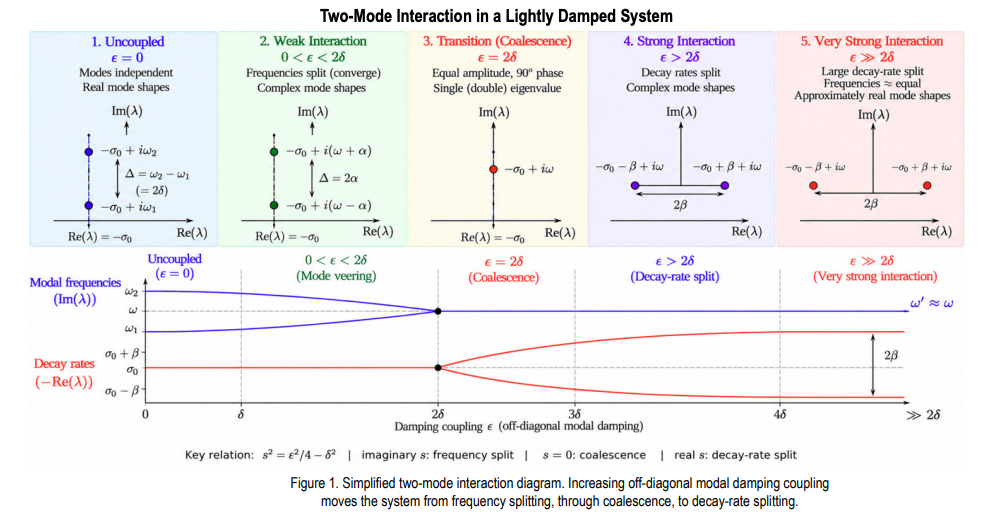
Complex modes can appear in lightly damped structural systems due to closely spaced modes. In classical modal analysis, lightly damped structures are often treated as nearly proportional systems with real mode shapes, which can be misleading when two modes are close together. The critical question shifts from whether damping is negligible to whether the coupling between the modes is substantial relative to the baseline half-frequency separation δ = (ω2 - ω1) / 2.
To analyze this, define the central eigenvalue λ0 ≈ -ζω + iω and express the coupled eigenvalues as λ1,2 = λ0 ± s. Under conditions of light damping and close-mode asymptotic assumptions, the local quartic eigenvalue problem simplifies to s² = ε²/4 - δ². This single relation determines the eigenvalue separation in the complex plane. For a detailed visual representation, refer to Figure 1.
From an engineering perspective, the complexity observed in a mode shape should not be automatically attributed to heavy damping, nonlinearity, or subpar test data. When examining closely spaced modal pairs, consider the complex poles in conjunction with the mode-shape phase. Frequency convergence, accompanied by near-quadrature modal components, suggests the imaginary-s regime.
Conversely, nearly equal frequencies, along with decay-rate separation, indicate the real-s regime. This framework establishes a practical bridge between test analysis and theory: the interaction strength can be estimated using the effective interaction parameter s = (λ1 - λ2) / 2, while the spacing δ can be approximated from the uncoupled or pretest analytical modal spacing. Utilizing these quantities allows for the determination of proximity to the transition boundary.
Written by urgent.news from NASA Science's reporting — not their text. Machine-written — may contain errors; check the original before relying on it.