Samsara makes AI agent platform generally available, reports 7x adoption growth
Samsara has made its no-code Agent Studio platform generally available, allowing customers to build AI agents for tasks such as driver compliance monitoring, operational reporting and driver communication. The company says usage has grown rapidly, though customer adoption and financial returns remain unclear. The post Samsara makes AI agent platform generally available, reports 7x adoption growth…
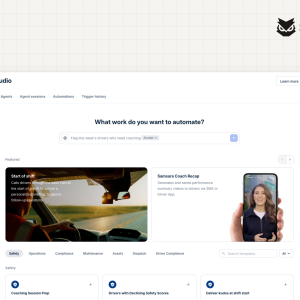
Samsara has released its Agent Studio platform to all customers, enabling fleets and other businesses to construct no-code AI agents. The company has observed a sevenfold increase in the usage of these agents, with 500,000 interactions occurring within just 16 days, as opposed to the initial 112 days. Samsara gauges the adoption of AI agents by the count of interactions, which involves a full agent session via chat or voice.
Voice agents have outpaced chat interactions since their debut, maintaining this lead consistently. The majority of these voice interactions are initiated by agents and customized by the organizations employing them. Over 1,000 organizations are utilizing Samsara agents weekly, although the exact number of organizations relying on voice agents alone remains undisclosed.
Samsara launched Agent Studio in June but made it broadly accessible to customers on Tuesday. This platform empowers customers to create bespoke AI agents utilizing operational data to execute tasks like generating reports, identifying potential hours-of-service violations, and responding to drivers' inquiries based on company policies.
The specific details regarding the number of customers utilizing agents in production or those who have built custom agents have not been disclosed by Samsara. Agent Studio is incorporated into existing Samsara subscriptions. The announcement coincides with logistics companies seeking to transition AI projects from pilot programs to operational use with tangible returns.
A March 2026 survey conducted by Boston Consulting Group among more than 180 logistics providers and shippers revealed that 40% of logistics service providers have deployed AI beyond pilot programs, yet only 10% have scaled it to core operations, with only 13% reporting measurable value from AI. The primary obstacles to wider adoption include unclear returns on investment and deficiencies in internal capabilities.
A September 2026 survey by Descartes indicated that 19% of shippers and 15% of logistics service providers are currently leveraging AI at scale. These findings indicate that while AI is gaining traction in the transportation sector, many companies have yet to fully integrate it across their operations. Johan Land, Samsara’s chief product officer, attributed the rapid adoption of AI to its usefulness in physical operations, emphasizing that an agent must comprehend the operation and connect with people where the work occurs.
Samsara reported several customer examples utilizing agents for tasks such as report compilation, compliance monitoring, and driver communication. Grand Isle Shipyard employs an agent to compile forms, inspection reports, and asset data into monthly reports within five minutes per division, reducing report-generation time by 99% and potentially saving around $100,000 annually in specialist capacity (although the specific calculation for this figure was not provided).
S. Bertram Foods utilizes an agent to monitor remaining stops, driving time, and shift time, flagging potential hours-of-service violations three hours in advance, which has cut weekly manual review time by 84%. StreamTech Industrial employs an agent to identify trips where drivers have not logged into their vehicles, resulting in a reduction of 500 hours of unassigned driving over two months.
These customer outcomes were provided by Samsara, but the company did not specify the detailed measurement methods for these reported improvements. Voice agents enable AI to reach drivers within the cab, offering instructions upon arrival at unfamiliar facilities, including information on entrances, parking, yard speed limits, and necessary safety equipment.
Drivers can ask follow-up questions, while managers can investigate issues, such as extended facility stops, using operational data. Specifically, Samsara's voice agents operate hands-free through dash cams, which is crucial as federal regulations prohibit commercial drivers from holding a phone while driving but permit hands-free phone usage.
Agents can be configured to activate under specific conditions, such as when a vehicle enters or exits a designated geofence. Additionally, Samsara offers Samsara Assistant, allowing users to query operational information through its software dashboard, and Samsara MCP, which connects authorized Samsara data to external AI tools like ChatGPT, Claude, and Microsoft Copilot.
Agent Studio introduces a means for customers to develop custom chat and voice agents tailored to their unique workflows. For freight and logistics operators, the potential advantage lies in reducing the time spent on gathering information, monitoring compliance, and responding to routine inquiries. However, the announcement provides limited evidence of the extent to which agents are deployed or whether the reported time savings translate into lasting financial gains. These factors will be crucial as logistics companies contemplate further investment in AI.
Written by urgent.news from FreightWaves's reporting — not their text. Machine-written — may contain errors; check the original before relying on it.