Photos: Taiwan’s tea revival blends ancient terraces with new climate adaptations
SHENKENG, Taiwan — Ten kilometers east of Taipei’s high-rises and dense traffic, the city gives way to a succession of steep, forested ridgelines sheltering villages in the valleys below. The subtropical mist that cloaks these slopes at dawn has already thinned, and by 9 a.m. the heat is climbing. Li Chao-shiang, an assistant professor in […]
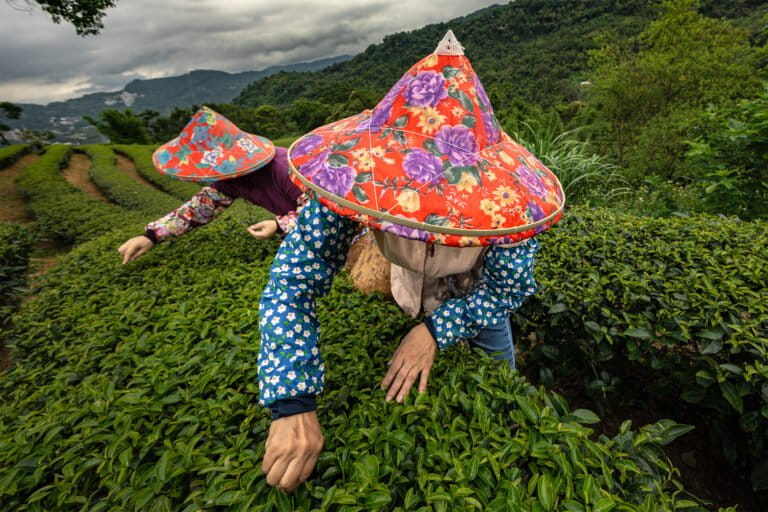
SHENKENG, Taiwan — Ten kilometers east of Taipei's towering skyscrapers and congested streets, the city transitions into a series of rugged, forested ridgelines that cradle villages in the valleys below. The cool, misty climate that blankets these slopes at sunrise has already dissipated by 9 a.m., with the temperature steadily rising.
Li Chao-shiang, an assistant professor in the Department of Interior Design at China University of Technology in Taipei, treks upward along a small stone pathway, intermittently wiping the sweat from his brow. As he rounds a bend, he halts at an opening in the underbrush. Half of the hillside before him is blanketed in dark-green rows, resembling the regular stripes of cultivated land.
The remaining half resembles a gash through the forest. "This jungle harbors a secret," Li remarks. "If you examine the hills encircling us closely, faint lines still trace through the forest. They might appear insignificant now, yet they represent stone terraces—remnants of one of the world's most renowned tea empires."
For most of the late 19th and early 20th centuries, tea transformed these hills into valuable assets. By 1897, tea constituted 22% of Taiwan's export revenues, fourfold the worth of sugar, with 96% of Taiwan's Formosa oolong tea bound for New York and Chicago. Shenkeng's distinctive style, the lightly oxidized Wenshan pouchong, emerged around 1912 and underwent refinement throughout the 1920s, becoming Taiwan's primary export to Southeast Asia. "The soil..."
Written by urgent.news from Mongabay's reporting — not their text. Machine-written — may contain errors; check the original before relying on it.