Bike lane advocates to challenge Ford government’s removal plans at Supreme Court
Ahead of the lane removal, CycleTO and EcoJustice, two groups that launched the charter challenge, revealed they are appealing the case to Canada's highest court.
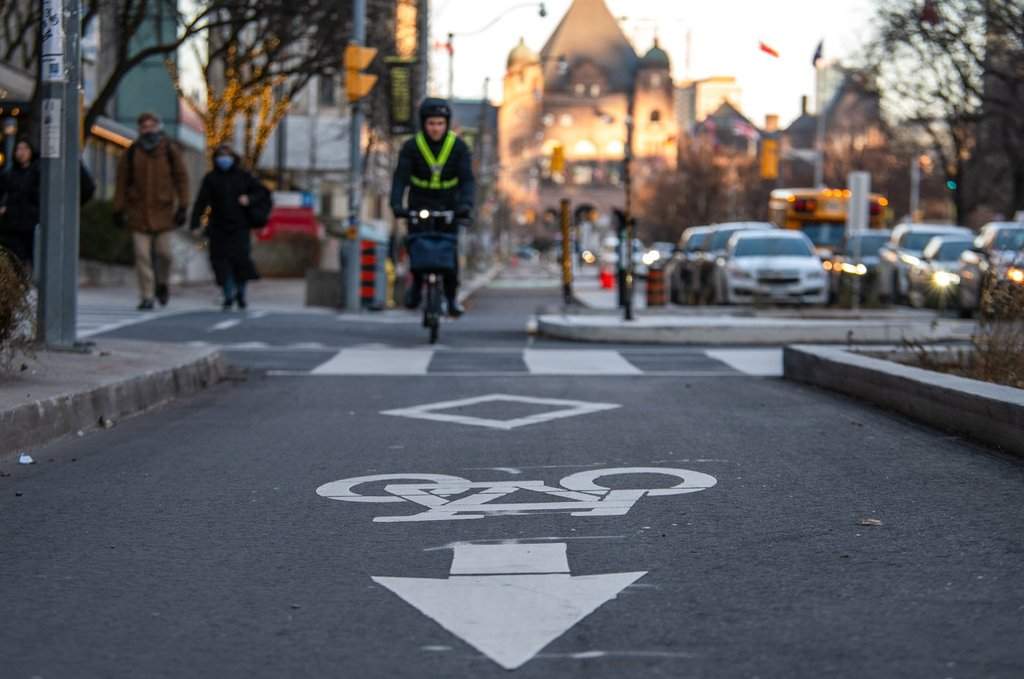
Cycling advocates in Toronto are preparing to take the Ford government’s bike lane removal plans to the Supreme Court of Canada. The Ontario Court of Appeal recently ruled that removing bike lanes on three major streets does not violate the Canadian Charter of Rights and Freedoms, allowing the government to proceed with its plans.
This decision reactivated a policy put in place by the Ford government at the end of 2024, which aims to restore space for vehicles by removing bike lanes from portions of Bloor Street West, Yonge Street, and University Avenue. The government announced that it will begin this process by reverting a 600-meter section of Bloor Street to vehicle-only lanes.
Two groups, CycleTO and EcoJustice, launched a charter challenge against the government’s plan. They are now appealing the case to Canada’s highest court, seeking to have the policy declared unconstitutional and to examine the government’s authority to implement potentially life-threatening legislation. Bronwyn Roe of Ecojustice explained that the case has far-reaching implications, as it could provide clarity on the scope of rights to life and security of the person protected by Section 7 of the Charter.
In the August ruling that allowed for the bike lane removals, Justice Grant Huscroft criticized the lower court for meddling in legislative policy. He stated that courts should not interfere in matters of legislative policy. However, advocates argue that their substantive arguments regarding the bike lanes' impact on traffic congestion and riders' safety still hold. Transportation Minister Prabmeet Sarkaria emphasized that the ruling reinforced the government's mandate to address gridlock.
Cycle Toronto’s executive director, Michael Longfield, maintained that the court’s decision did not overturn the factual findings of the superior court. He emphasized that the removal of bike lanes does not contribute to traffic congestion and could put lives at risk. Longfield also pointed out that there is no network of side streets to replace the lost bike lanes.
The Supreme Court of Canada will only hear the appeal if the case raises a question of public importance. This could include issues involving the interpretation of constitutional rights, new legal issues, or the need to resolve conflicting decisions from courts of appeal.
Written by urgent.news from Global News's reporting — not their text. Machine-written — may contain errors; check the original before relying on it.
This story
This is one outlet's version. Read the fullest account.
- Inside the Opposition’s Supreme Court plea: Bulk objections, opaque election roll database hindustantimes.com
- Supreme Court turns away Kari Lake lawyer's challenge to sanctions in Arizona voting machine lawsuit thehill.com
- Court dismisses mother’s bid to halt eviction to remain in Umhlanga property near son’s school iol.co.za
- Bike lane advocates to challenge Ford government’s removal plans at Supreme Court globalnews.ca
- Supreme Court gives three more months to CBI to complete probe in custodial death case thehindu.com
- Supreme Court sides with Trump administration in lawsuit seeking records on Elon Musk's DOGE pbs.org
- Supreme Court sides with Trump administration in lawsuit seeking records on Elon Musk’s DOGE winnipegfreepress.com
- ‘Duty bound to protect’: Madras High Court upholds school official’s POCSO conviction indianexpress.com