Simulating student learning for better AI tutoring
StudentSim is a research system for evaluating and improving AI tutoring tools before they are tested with learners. It models how individuals may engage with tutors, giving feedback to improve tutor performance across subjects like chess, writing, and mathematics. The post Simulating student learning for better AI tutoring appeared first on Microsoft Research .
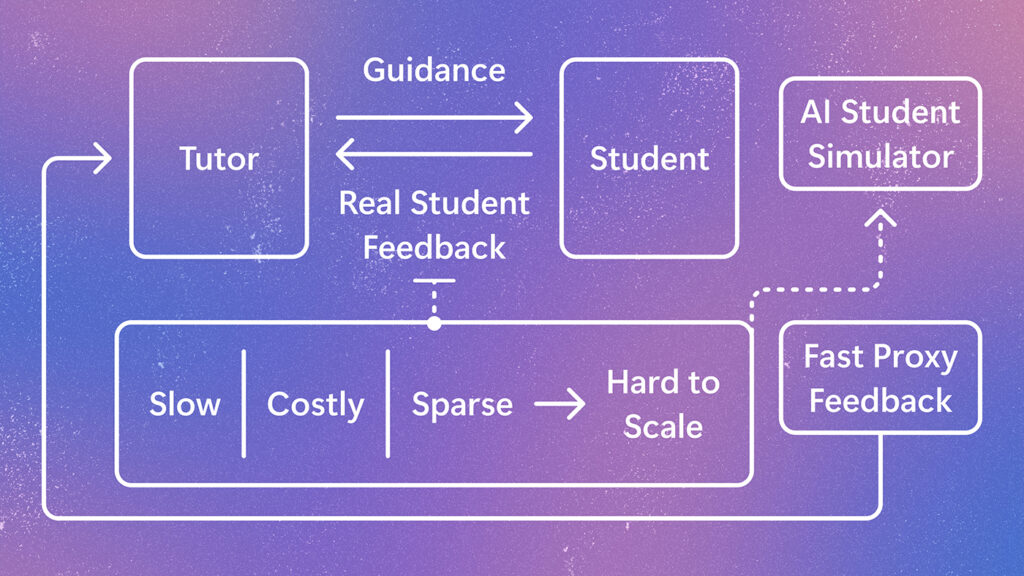
At a glance, StudentSim is a research system designed to evaluate and enhance AI tutoring tools before they are tested with actual learners. This system is not meant for product deployment or classroom use, and its primary goal is not to replace human teachers. The importance of collecting student feedback during AI tutoring tool development is evident, but gathering this feedback through human studies can be slow, costly, and difficult to scale.
StudentSim aims to address this challenge by creating personalized simulators of individual students, modeled based on publicly available, de-identified learner records. These simulators adapt to each student, providing an early-stage research signal for tutoring systems without replacing the role of teachers in the classroom.
The work of StudentSim evaluates the AI tutors along two education-grounded dimensions: whether the simulators respond like a specific student and whether they update after receiving tutor guidance. In chess, second-language English writing, and mathematics, StudentSim has demonstrated superior performance compared to leading baselines, offering valuable feedback for training AI tutors.
In research settings, teams are exploring how AI-powered tutoring systems can assist in explaining math problems, suggesting edits to writing assignments, or guiding learners through chess positions. However, measuring the quality of teaching using only the tutor's answer is insufficient. A tutor must also understand the impact of the guidance on the student's learning process.
StudentSim tackles this issue by providing a signal on whether a simulator matches a specific student's independent behavior and whether it responds to guidance.
The StudentSimEval benchmark and evaluation protocol span across chess, second-language English writing, and mathematics, focusing on two key aspects: behavioral fidelity and guidance responsiveness. Behavioral fidelity measures whether the simulator matches a specific student's recorded responses on held-out problems, while guidance responsiveness determines if the simulator updates its response after receiving tutor guidance.
These two goals complement each other, as a simulator that only mirrors past student behavior may be good for prediction but not for evaluating teaching interventions, and a simulator that always follows the tutor's suggestions may provide fluent responses but fail to represent a student's true strengths, weaknesses, and likely mistakes.
To train these personalized simulators, StudentSim uses sparse student records from publicly available learner datasets. No personally identifying information is used throughout the process, ensuring the preservation of student privacy. Ultimately, StudentSim helps researchers evaluate and improve AI tutoring systems during the research and development phase, offering a useful feedback signal before testing them with real learners.
Written by urgent.news from Microsoft Research's reporting — not their text. Machine-written — may contain errors; check the original before relying on it.