CNA Explains: What are hypersonic weapons, who has them and why do they matter for Asia?
South Korea tested a hypersonic weapon on Oct 8, days after North Korea launched what it claimed was a hypersonic missile, drawing fresh attention to the technology and its implications for regional security.
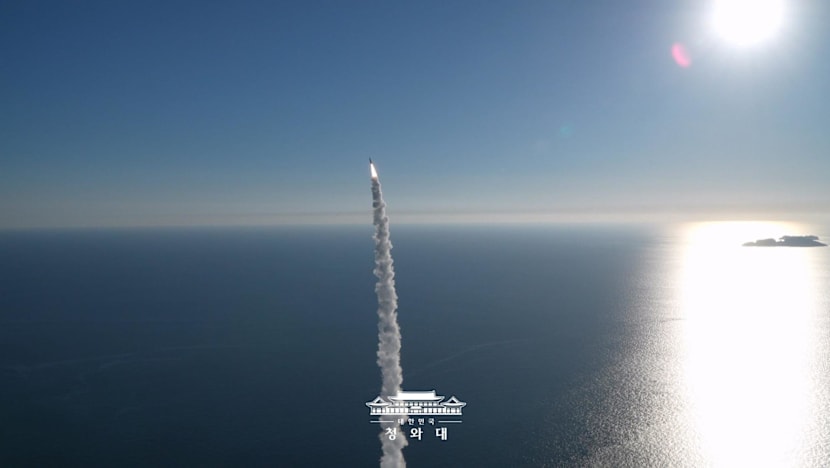
On Oct 8, South Korea successfully tested its first domestically developed hypersonic weapon, heightening concerns over the advanced technology's potential game-changing capabilities in the region. This comes just days after North Korea claimed to have launched a hypersonic missile of its own, intensifying regional security tensions.
Hypersonic weapons are defined as those traveling at least five times the speed of sound, or Mach 5. These weapons are distinguished by their ability to maneuver during flight. There are two main types: hypersonic glide vehicles and cruise missiles. The former is launched via rocket boosters and then glides towards targets without sustained engine power, while the latter uses specialized engines, typically air-breathing scramjets, to sustain high-speed flight.
South Korea's test was of a hypersonic glide vehicle, capable of having ranges of up to thousands of kilometers, effectively making it an intercontinental ballistic missile (ICBM) equivalent, as per the Center for Arms Control and Non-Proliferation. In contrast, hypersonic cruise missiles use scramjets to maintain high-speed flight.
Hypersonic weapons can carry either conventional or nuclear warheads. The challenge lies in their extreme speed and manoeuvrability. Unlike traditional ballistic missiles, which follow a predictable high, arcing trajectory, hypersonic weapons can travel at low altitudes, making them harder for ground-based radar systems to detect due to the Earth's curvature. Their ability to change course further complicates interception efforts, making it difficult to predict where they will strike.
Several countries, including China, Russia, the United States, South Korea, and India, are developing hypersonic weapons, though few have confirmed operational capabilities. China and Russia are considered leaders in this race. Beijing has deployed the DF-17 hypersonic missile system and showcased several hypersonic anti-ship missiles at a military parade.
Russia, on the other hand, has deployed the Avangard hypersonic glide vehicle and Zircon cruise missile, both of which have entered service. The United States has tested hypersonic weapons and deployed its Long-Range Hypersonic Weapon, known as Dark Eagle, for military exercises. South Korea's test marks a significant step in its development program, though the weapon is not yet fully operational.
North Korea's claims of hypersonic missile tests remain uncertain regarding their actual capabilities and readiness. The spread of hypersonic weapons could have significant regional security implications, potentially undermining the credibility of US extended deterrence in the Indo-Pacific region.
Written by urgent.news from Channel News Asia's reporting — not their text. Machine-written — may contain errors; check the original before relying on it.