Brandgefahr in großer Höhe: Powerbank im Flieger: Regeln und Anzeichen für kaputte Akkus
Schon wieder sorgt eine brennende Powerbank an Bord eines Flugzeugs für Gefahr. Welche Regeln für den Transport im Flieger gelten - und wie man erkennt, ob eine Powerbank kaputt sein könnte.
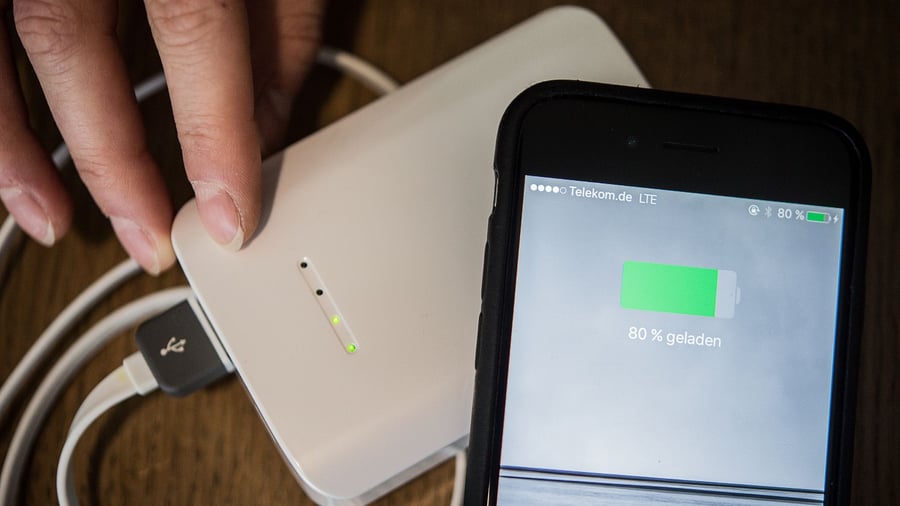
A power bank caught fire on a plane, thankfully managed to be contained in a fireproof container, allowing the aircraft carrying 204 passengers to land safely. Such incidents involving burning power banks on board are becoming more frequent. Recently, a Lufthansa flight from Frankfurt to Lisbon was diverted due to a power bank fire on board. Another incident occurred on October 11th, when a power bank caught fire in the luggage compartment of an Airbus on a flight from New Delhi to Chennai in India.
It is important to know about the energy storage devices in your luggage: Power banks with lithium-ion technology are generally not allowed in checked luggage. If a battery issue occurs, there may be no one to address it, and a fire could spread. Therefore, it is recommended to place them in hand luggage instead. Devices affected include not only power banks with USB ports, but also other batteries, e-cigarettes, and wireless earbuds with charging cases. It is best to check with your airline prior to departure for their specific regulations.
There are limits to the battery size. Depending on the airline, the limits may vary. For example, Ryanair allows only two power banks per person, while Wizzair allows only one. Lufthansa Group permits up to two devices per person, with a capacity of 100 watt-hours (Wh) each. Approvals are possible for 160 Wh, but anything above that must remain on the ground.
The capacity of your power bank is usually indicated on the back of the device. Sometimes it is also printed in milliampere-hours (mAh). To convert mAh to Wh, use the formula: Wh = mAh x Voltage / 1000. Lithium-ion batteries in smartphones typically operate at a voltage of 3.7 volts. For a power bank with a capacity of 10,000 mAh, this would be 37 Wh. This power bank should be allowed on board.
Usage on board also has rules. It is important to inquire about your airline's specific regulations to avoid bringing a power bank on board that cannot be used. Charging your phone, tablet, headphones, and other devices while on board is generally prohibited, as charging the power bank itself may also be restricted. Some airlines require the power bank to remain accessible throughout the flight, which means it should not be stored in the overhead compartment.
Moreover, operating essential and approved medical devices is allowed. If your power bank has been damaged or has certain signs of malfunction, such as frequent falls with visible damage, overheating during operation, deformation, or discoloration around the connectors, it is better to dispose of it properly and purchase a new one.
When buying a new power bank, look for the CE mark, which is the minimum requirement. The GS mark indicates an independent technical test. If there are incomplete or missing manufacturer information or technical data, it should be a warning sign. Additionally, avoid devices from discount online shops, as they may not have the necessary safety features against overcharging, deep discharge, or overheating.
Written by urgent.news from Handelsblatt's reporting — not their text. Machine-written — may contain errors; check the original before relying on it.