Modder discovers that putting a GPU in the 'wrong place' can deliver a 19 degree cooler hotspot
In PC DIY it might still be worth challenging convention, as TrashBench shows with his GPU hotspot getting up to 19C cooler.
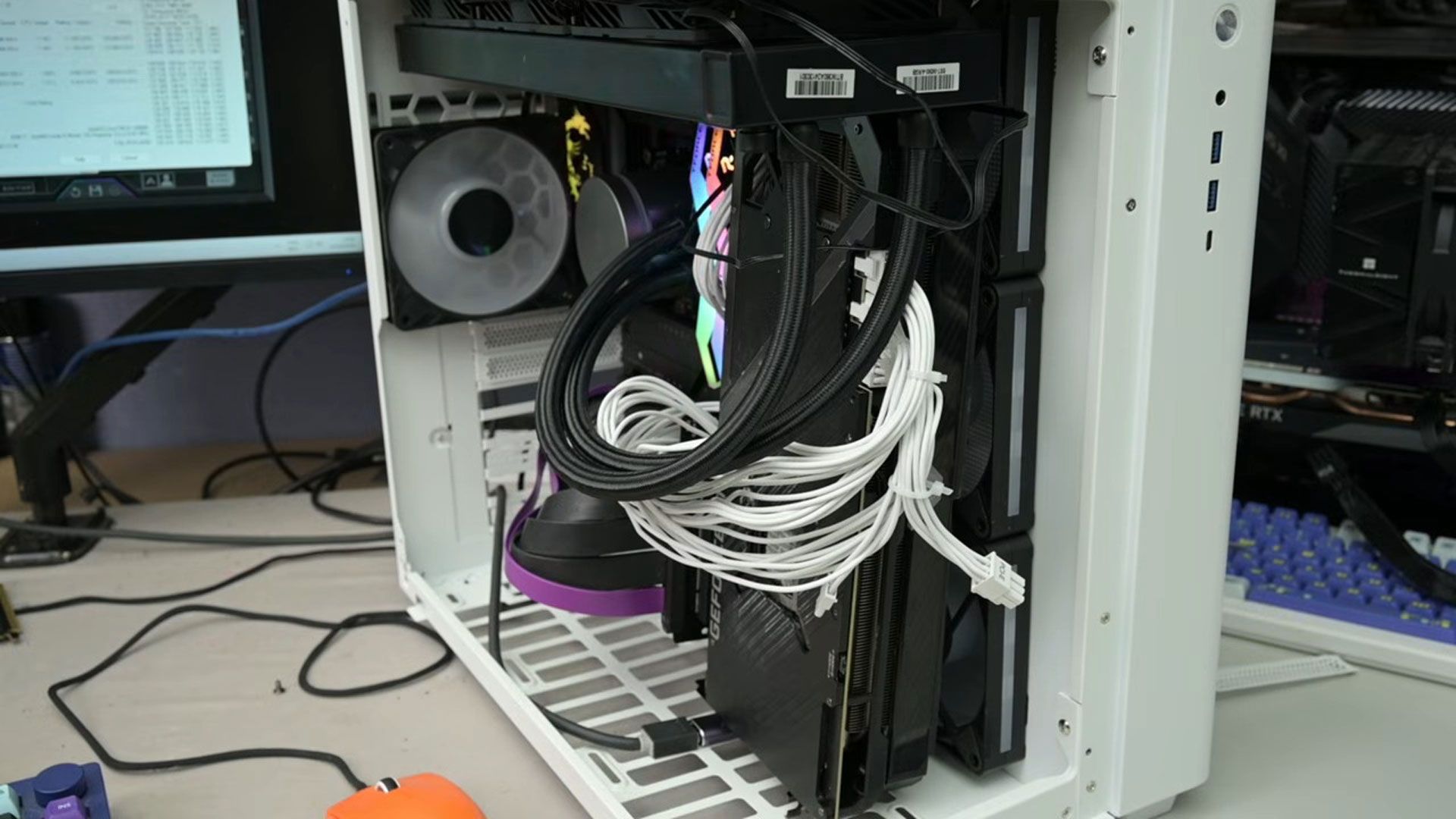
Modder TrashBench discovered a surprising cooling technique that can reduce GPU hotspot temperatures by up to 14 degrees Celsius and CPU temperatures by 3.3 degrees Celsius, challenging the conventional wisdom of desktop PC construction. Following established norms, the modder initially built an RTX 3080 desktop PC with the CPU cooled by a 360mm AIO and the triple-fan GPU seated in the standard PCIe slot.
After establishing a baseline for performance under constant thermal load, TrashBench began experimenting with unconventional GPU placements.
First, he placed the GPU at the bottom of the case, vertically and to the side, facing different directions, and positioned between the side case fans. He also tested the CPU AiO cooler with the radiator fans either pushing or pulling air. The results showed that certain GPU and CPU configurations favored cooling one component over the other, but the optimal balance yielded significant cooling benefits for both.
After analyzing the best configurations, TrashBench refined his cooling design by mounting the CPU vertically against the side intake fans, while placing the CPU AiO radiator in a traditional exhaust configuration. This sweet spot configuration delivered a 3.3°C cooler CPU and chilled the GPU hotspot by 14°C. To achieve this GPU repositioning, a PCIe riser cable is necessary. TrashBench successfully demonstrated this alternative cooling approach with various PCIe riser lengths.
Written by urgent.news from Tom's Hardware's reporting — not their text. Machine-written — may contain errors; check the original before relying on it.