🔮 The end of screen time
AI changes how we work, but can it also change where?
I reside in Amsterdam and regularly commute to London every few months to spend quality in-person time with the EV team. Upon arriving at my hotel room on Monday, an unexpected discovery awaited me - my laptop was left back home. A year ago, the absence of my laptop would have left me utterly disoriented, especially given my office workload.
For generations, office work has been centered around computers: Slack, Word documents, Excel spreadsheets, all meticulously crafted under the assumption that one would sit at a desk, typing away. However, this fundamental premise is a fabrication we've constructed around our lives. This week, without my laptop in hand, I observed this fabrication weakening, leading me to believe that it will eventually vanish due to the utilization of AI agents.
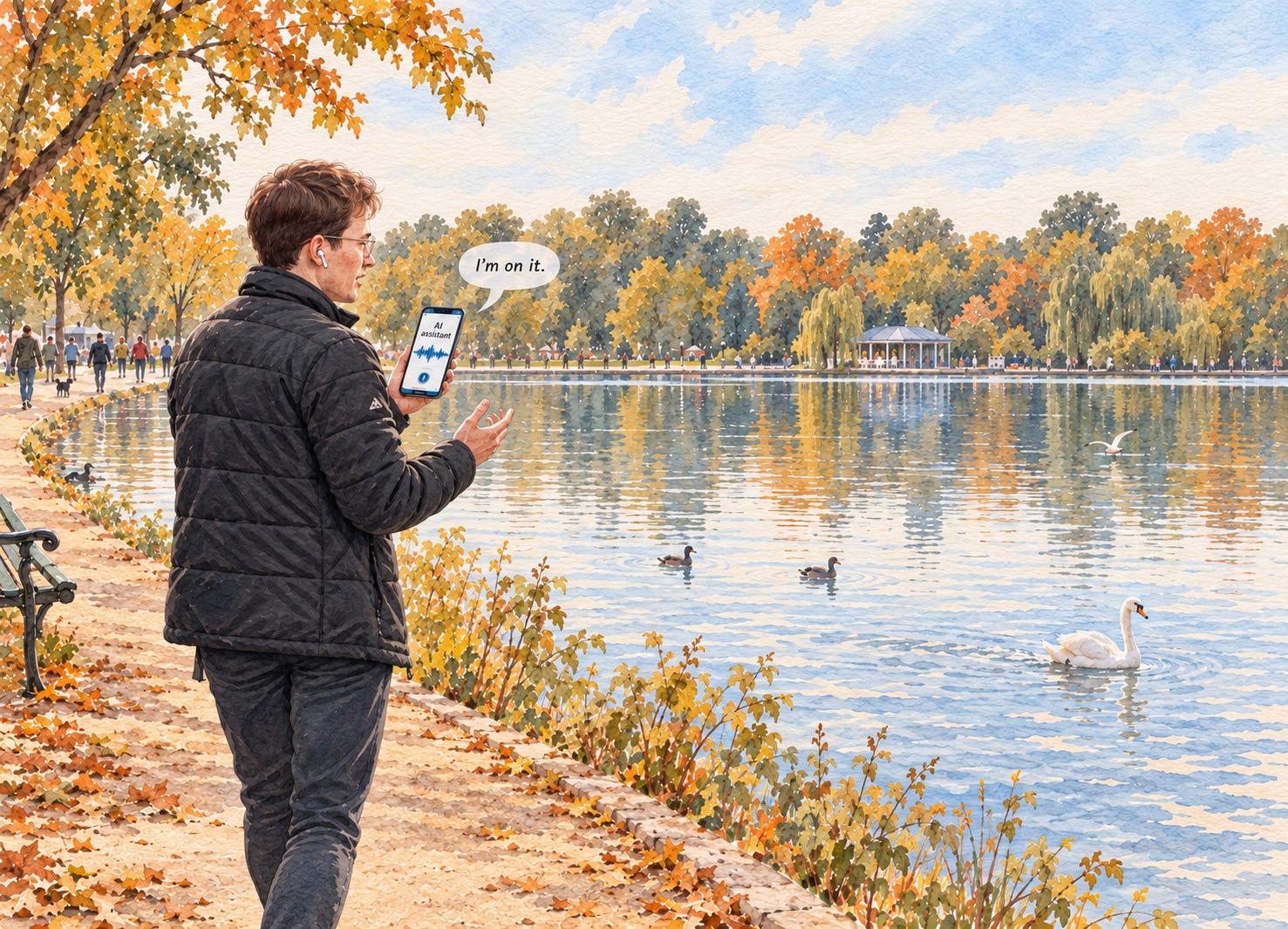
Throughout this week, I primarily managed my tasks by conversing with ChatGPT on my smartphone. Hence, I am not replacing traditional desk work with squinting at miniature screens or straining my neck over a display; instead, I am engaging in dialogue and receiving the work in return. This advancement is attributed to OpenAI's July release of GPT-Live, a feature enabling voice-directed agent interaction.
I consider this development significant and believe it warrants more attention. It feels akin to conversing with Jarvis, Iron Man's AI assistant. Just like Jarvis, GPT-Live can assist in carrying out our workshop tasks (for now, that workshop primarily exists in the digital realm). Abandoning my laptop prompted a real-life experiment to gauge the extent to which my daily work could be accomplished via voice assistant.
I eagerly look forward to sharing my setup and insights gleaned from this week of working exclusively with my voice.
Written by urgent.news from Exponential View's reporting — not their text. Machine-written — may contain errors; check the original before relying on it.