30 old Intel Mac minis are hugely faster than the Cray-1 chassis they live in
It's not Xgrid, but a computing museum in Spain has recreated a Cray-1 supercomputer to a 1:1 scale, using a total of 30 Intel Mac minis to generate up to 1.5 teraflops of performance. A replica Cray-1 made with Mac minis - Image Credit: Museo de Historia de la Computacion/Facebook Sometimes, efforts to recreate famous old computer systems involve the use of more modern parts. In the case of one…
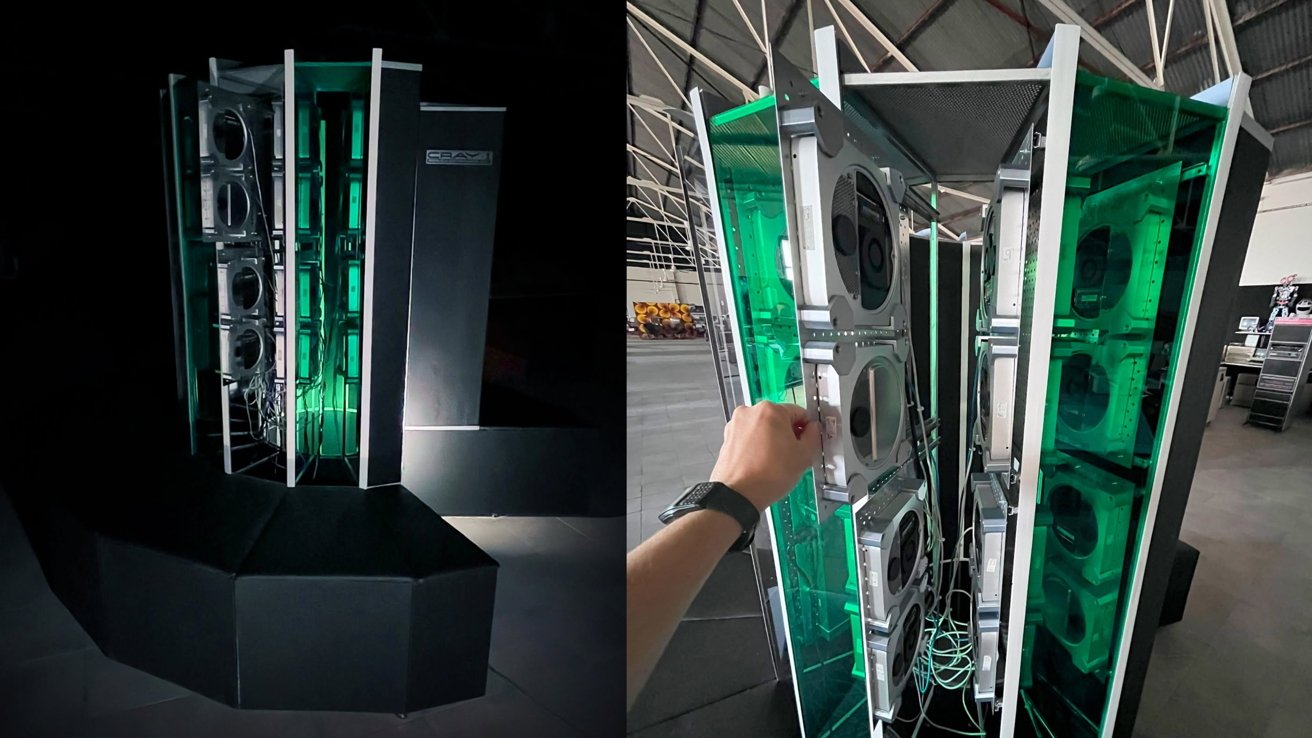
The Museo de Historia de la Computación in Spain has revealed a 1:1 scale visual replica of the iconic Cray-1 supercomputer from 1976. To power the system, the creative team utilized 30 Mac Minis from 2012. This project, developed over 18 months, celebrates the 50th anniversary of the Cray-1 and Apple's founding. Although Mac Minis from a decade ago may not appear suitable for constructing a cluster supercomputer, when connected, the developers can coordinate 64 active processing cores to achieve a combined performance of 1.3 teraflops in their latest tests.
Previously, the museum achieved 1.5 teraflops by using all 70 available cores, before one node went offline. These benchmarks were obtained using a custom matrix-multiplication Python script. The cluster consists of five quad-core i7 PCs and 25 dual-core i5 models, with the majority of units dating back to 2012, except for two from 2014.
The replica serves as an invaluable tool for museum visitors to grasp the evolution of computer architecture since 1976. The original Cray-1 employed vector processing, executing a single instruction on multiple data elements simultaneously, while the replica distributes tasks across independent processors in a parallel cluster.
The Cray-1's peak theoretical performance was around 160 megaflops. Despite being a purpose-built research machine, the replica has been recreated using consumer hardware that is significantly more powerful than the original machine it honors.
Written by urgent.news from Ars Technica's reporting — not their text. Machine-written — may contain errors; check the original before relying on it.
This story
This is one outlet's version. Read the fullest account.
- A Cray-1 supercomputer replica from 30 "obsolete" Mac Minis arstechnica.com