The Most Distant FRB Tells The Story Of Its Origin
Astronomers use the Webb to study a distant fast radio burst and reveal clues as to the origin of these mysterious events.
Fast Radio Bursts (FRBs) pose a challenge for scientists due to their brief duration and elusive nature. Initially, distinguishing FRBs from terrestrial noise proved difficult. However, with advancements, it became evident that most FRBs emanate from distant galaxies, suggesting they are triggered by intense, rapid astrophysical processes.
The most plausible explanations are the merger of neutron stars forming a black hole or a flare-like event on a magnetar's surface. More speculative theories include the collapse of dark-matter stars. Despite these possibilities, pinpointing the exact origin remains challenging as the only available data is the radio bursts themselves.
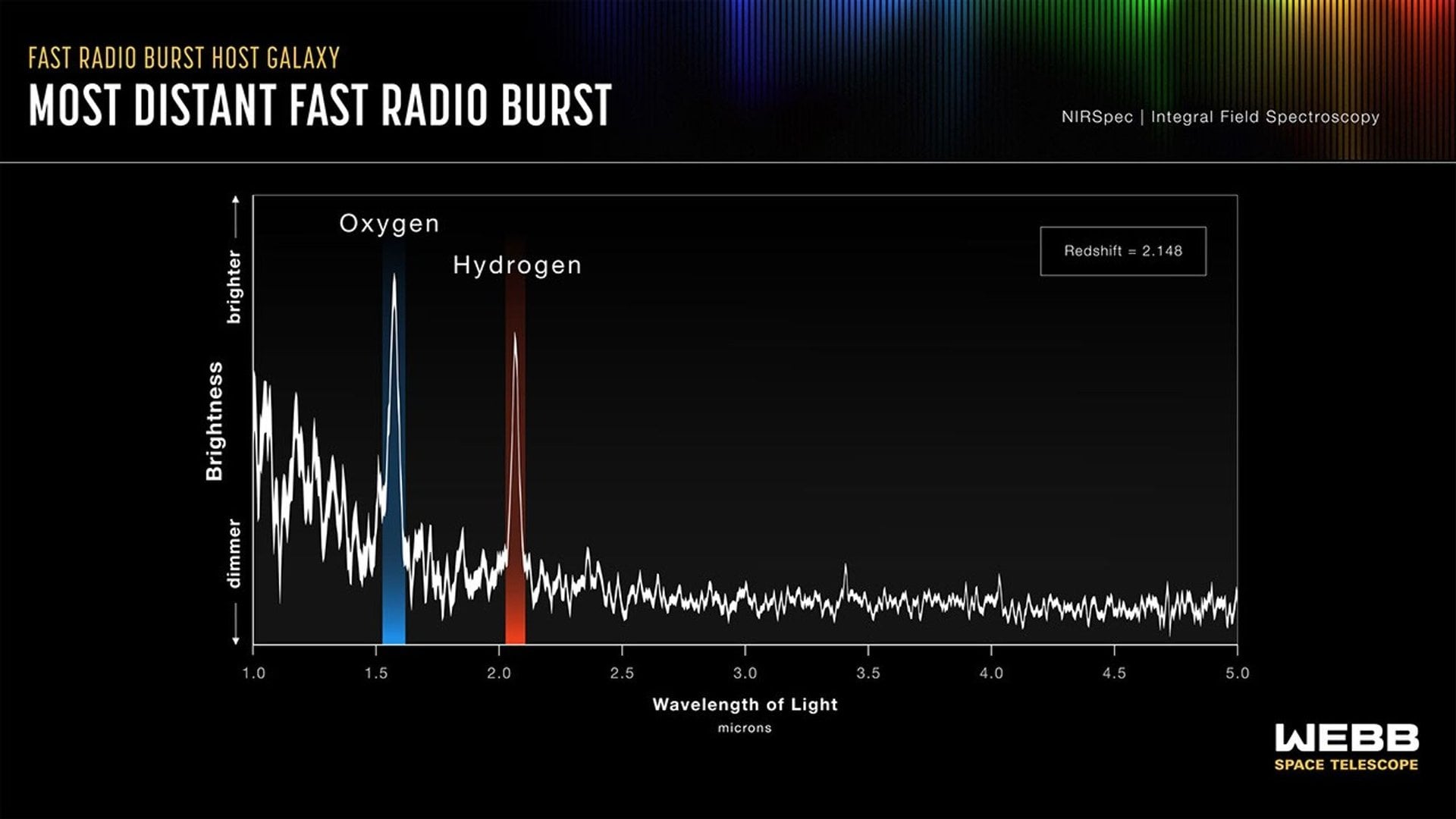
In 2024, the MeerKAT radio array observed FRB 20240304B, precisely pinpointing its location. Yet, optical observations of the area did not reveal any associated object. Recently, astronomers turned to the James Webb Space Telescope (JWST) to gain further insight. JWST excels at observing distant, faint galaxies, leading to the discovery of a small galaxy.
By analyzing the galaxy's spectrum, researchers determined that they were observing it during a period when the Universe was approximately 3 billion years old. This makes FRB 20240304B the most distant FRB ever detected. The spectrum of the galaxy indicates that most of its stars formed relatively young, around 30 million years ago.
This observation implies we are witnessing the galaxy in its early stages, filled with young stars. Typically, neutron star mergers require billions of years to merge after starting their spiral. Consequently, one would anticipate observing FRBs in mature galaxies with older stars. The presence of FRB 20240304B in a small, young galaxy suggests a different origin scenario—possibly that of a magnetar.
If magnetars are indeed responsible for FRBs, the expectation is to uncover even more distant events as research advances. Telescopes like MeerKAT could potentially detect such events from the very first billion years of the cosmos.
Written by urgent.news from Universe Today's reporting — not their text. Machine-written — may contain errors; check the original before relying on it.