Small stamps, big ambitions: A history of Middle East progress
I recently came across an article published by the Data Visualisation Society's Nightingale magazine that captures a niche but wonderful corner of a largely bygone era of stamps, graphic design, and data visualisation as political communications. Its author, Julie Peasley, assembled 180 stamps from around the world featuring charts and other data visuals from 88 countries. Among them are examples…
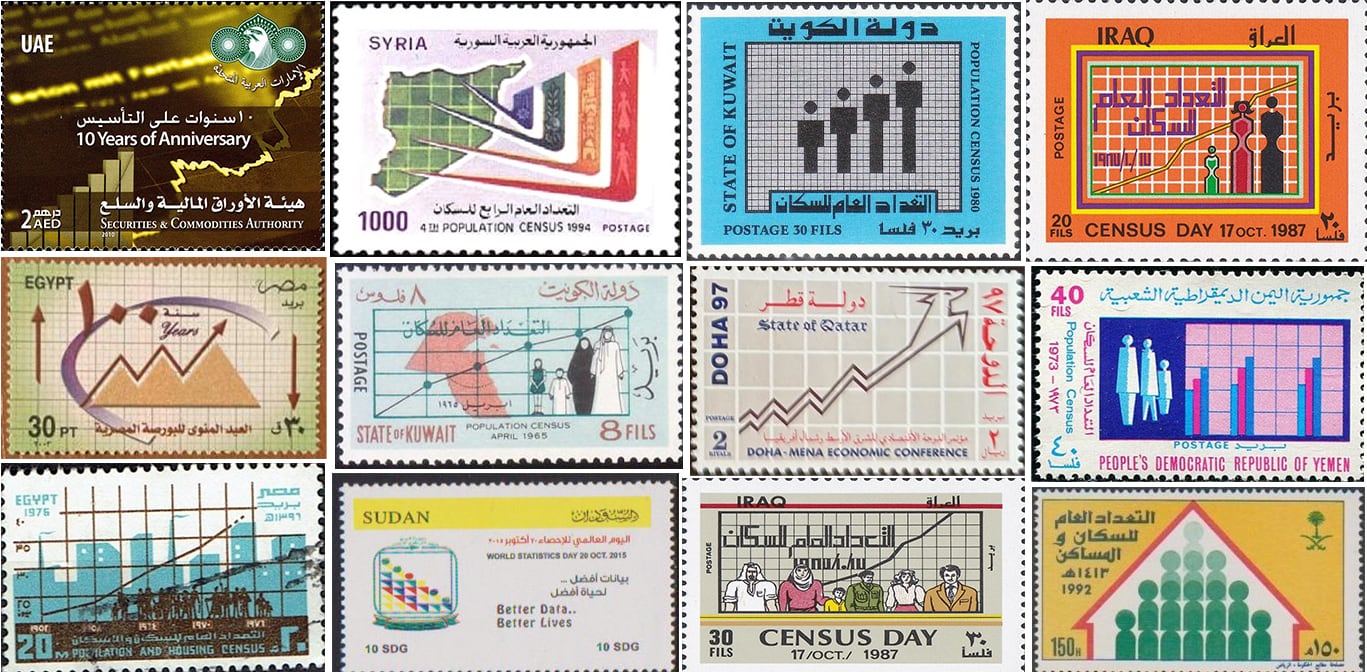
Middle Eastern countries have long used stamps to visually represent data and drive forward their ambitions. The Data Visualisation Society’s Nightingale magazine showcases 38 stamps from 14 countries across the Middle East and North Africa, spanning from 1940 to 2015.
One striking example is Iraq’s 1987 census stamp. Amidst the population boom and the grim backdrop of the Anfal campaign against Iraqi Kurds, the stamp highlights the country’s diversity with illustrations of rural and urban workers. The line graph reflects the population growth, but its issuance came amid a dark chapter in the nation’s history.
Egypt too made use of stamps to illustrate its progress. In 1976, during president Anwar Sadat’s “open-door” policy to attract investment, the stamp featured a cityscape against a turquoise background, alongside figures and a line chart marked with years and numbers. This stamp depicted Egypt’s ambitious shift towards modernisation.
Kuwait’s 1965 census stamp captures its rapid growth – nearly doubling in population from 1957 to 1965, with non-Kuwaitis constituting more than half of the residents. The stamp’s illustration of a family in traditional dress alongside a rising line chart underscores the significant economic, migration, and state-building changes experienced by the nation.
The UAE’s 1980 population census stamp is a testament to simplicity and beauty. Featuring a family against a pink grid, it symbolizes the young nation’s growth following its first general census in 1975. In Abu Dhabi alone, the population more than doubled between the two counts, from around 212,000 to 452,000.
Qatar’s 1997 stamp marked the Mena Economic Conference with an artistic line chart, turning economic growth into a commemorative design. Held in Doha in November 1997, the conference aimed to strengthen economic ties in the region following the Oslo Accords.
Egypt’s 2003 stamp commemorated the 100th anniversary of its stock exchange, combining a rising graph with a sweeping curved arrow. This design reflects forward momentum and movement, tying back to the exchange’s establishment in 1903 and the country’s evolving financial landscape.
UAE’s 1987 "Growth Monitoring" stamp, issued as part of Unicef’s Child Survival Campaign, exemplifies how data visualisation serves a practical purpose. By promoting simple and affordable measures like regular growth monitoring, breastfeeding, immunisation, and oral rehydration therapy, the stamp underscored the importance of data-driven initiatives in improving children’s lives.
Finally, Sudan’s 2015 World Statistics Day stamp takes a broader view of data’s power. With colourful triangles and circles accompanying the phrase "Better Data, Better Lives," it highlights how statistics can enhance people’s lives. The timing was significant, as the UN adopted the Sustainable Development Goals in 2015, emphasising the role of reliable statistics in measuring progress towards global targets.
Written by urgent.news from The National UAE's reporting — not their text. Machine-written — may contain errors; check the original before relying on it.
Also reported by 3 other outlets
- Small stamps, big ambitions: A history of Middle East progress thenationalnews.com
- 74pct of manufacturers report cost surge amid Middle East conflict nst.com.my
- US bolsters Middle East presence with 12 warships amid Iran tensions english.ajel.sa