Raven Chacon Sounds the History of the Land
The Pulitzer Prize-winning Diné artist talks about his recent performances at the Park Avenue Armory, the freedom of improvisation, and the privilege of “deep listening.”
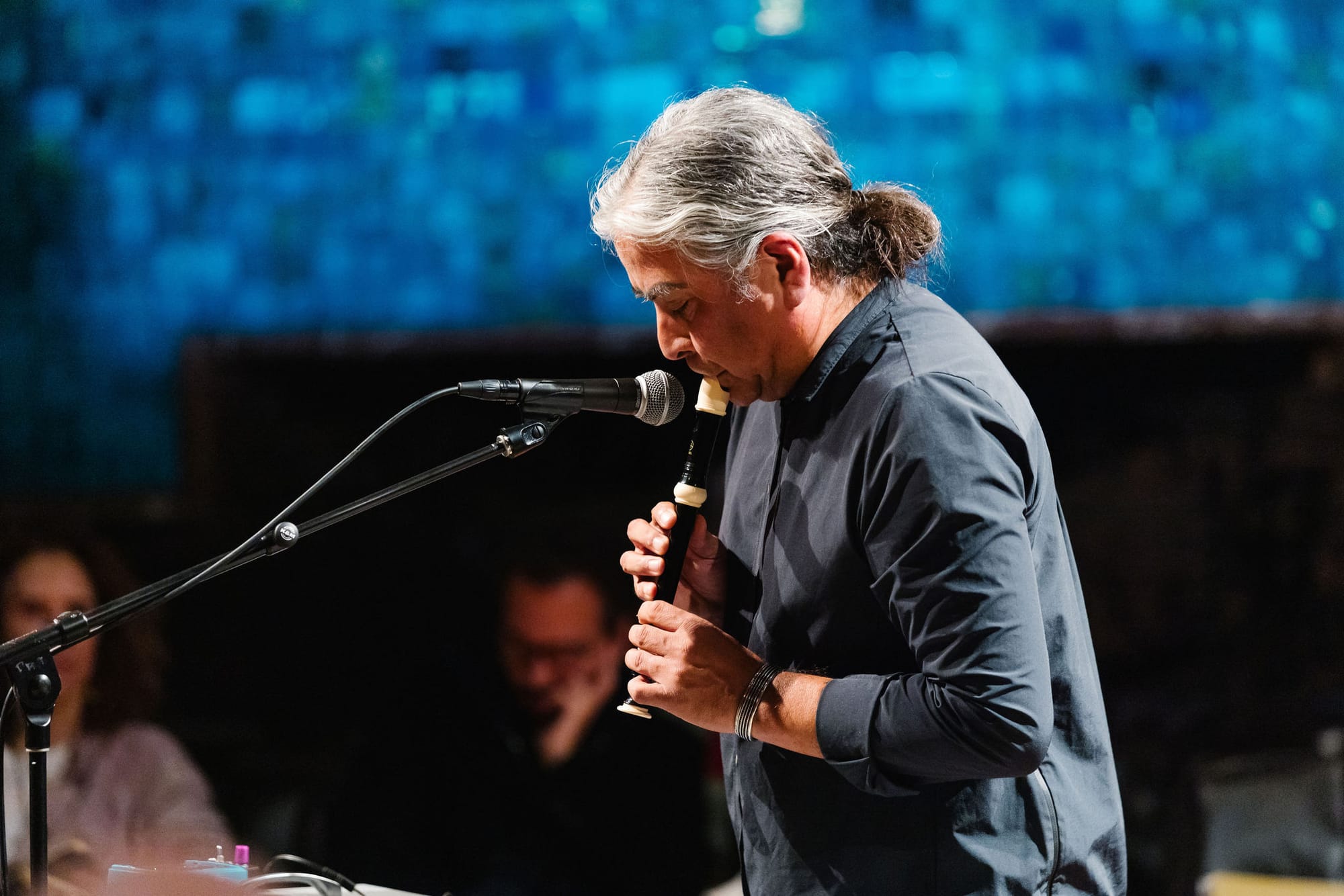
On Wednesday and Thursday, sound mixers, synthesizers, pedals, speakers, whistles, a turkey call, and a ceramic horn adorned a table at the center of Manhattan's Park Avenue Armory. The table served as the stage for Raven Chacon's hour-long improvisation sessions, giving audiences an unprecedented chance to witness the artist in action.
During his performance on October 8, Chacon utilized each object on the table in unexpected and at times unsettling ways. He blew a whistle into a microphone, looping the sound and layering it atop a rising drone, periodically interrupting it to allow for the electronic transmission of a breath he had recorded moments earlier. He mingled screeches over the whistles, eventually morphing the latter into a metallic sound akin to extraterrestrial signals in a science fiction film.
When the composition became too abstract, he would abruptly return to it with a clear, often intimidating reference to the world outside. Chacon concluded the session by playing recordings of wind through a hyperdirectional speaker, moving it around himself in a circle, transmitting the geography of alternate worlds that were less violent than the ones produced by the cars roaring up and down Park Avenue outside, yet whose continued existence hinged upon our willingness to listen.
In an interview with Hyperallergic following his performances at the Armory, Chacon discussed the role of location in his work, his use of tools associated with colonial violence, and his exploration of science fiction for an upcoming show at the San Francisco Museum of Modern Art. When asked about bringing site-specificity to an entirely improvised work, Chacon explained that he often incorporates field recordings of local natural history and Lenape culture and history of New York.
These recordings, gathered from his home in New Mexico, are brought indoors to mingle with other elements encroaching upon the interior space. Unavoidably, sounds from sirens and traffic outside become part of Chacon's soundtrack. He also considered the resonance of the sound piece based on the setting, comparing it to a "California earthquake" in a recent review of another exhibition he was part of.
Chacon's previous work often referenced the ground, with installations situated at the entry, followed by works involving soil and dirt. By moving through Chacon's performance, viewers experienced different interactions with materials and visual concepts, much like the various layers of soil and earth.
Written by urgent.news from Hyperallergic's reporting — not their text. Machine-written — may contain errors; check the original before relying on it.