Chinese researchers make Arctic-to-Antarctic call using rival to Musk’s Starlink
Polar researchers have used a would-be Chinese rival to Elon Musk’s Starlink to make a satellite video call between the Arctic and Antarctic – the first publicly reported test of the Guowang constellation. The call highlights the growing capabilities of the country’s satellite constellations, according to state media. Beijing has been accelerating the development of its low-Earth-orbit…
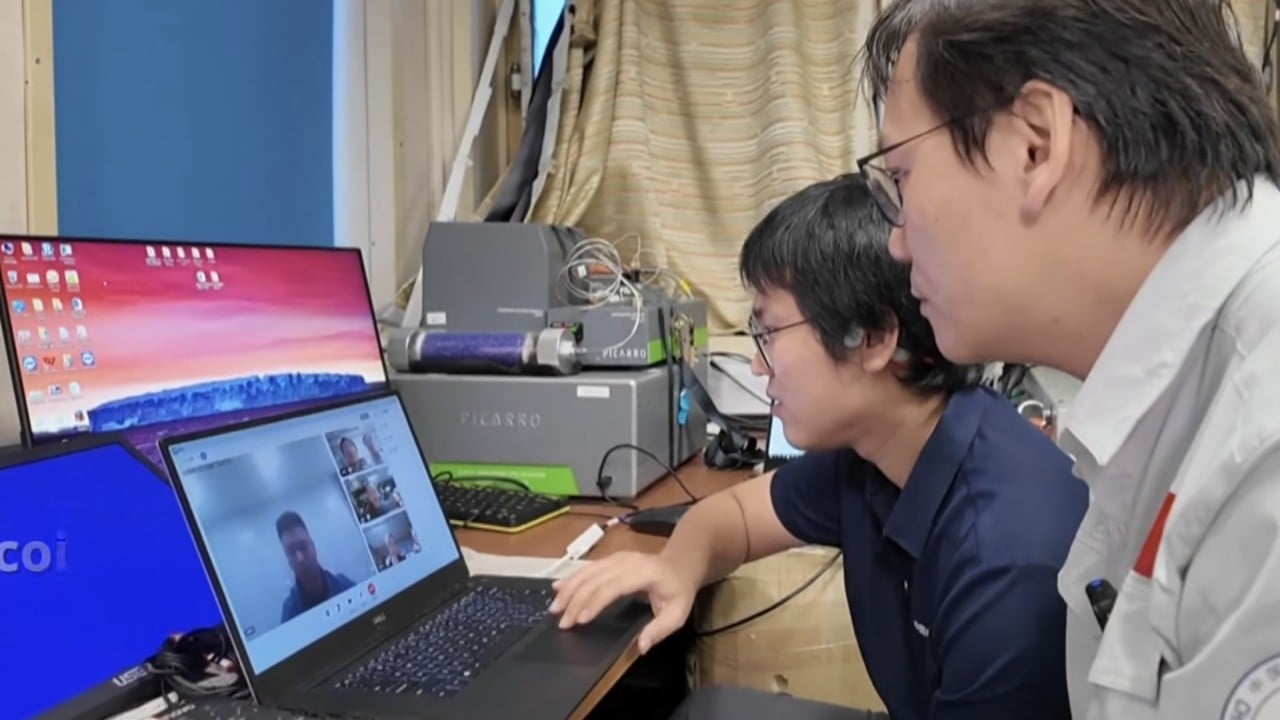
Chinese researchers have successfully utilized a Chinese satellite constellation, the Guowang, to establish a satellite video call between the Arctic and Antarctica, marking the first publicly reported test of the system. This achievement underscores the rapid advancements in China's low-Earth-orbit satellite capabilities, which have gained prominence as the United States' Starlink played a crucial role in aiding Ukraine during its conflict with Russia.
In late September, researchers aboard three Chinese Arctic expedition ships—Xuelong, Jidi, and Tansuo-3—conducted the near-real-time call with personnel at China's Qinling Station in Antarctica. The communication delay was reported to be less than one second. The Guowang constellation, operated by the state-owned China Satellite Network Group, is still in its early stages, with satellite launches commencing in December 2024, and only slightly over 180 satellites currently in orbit, out of a planned 13,000.
During the test, the researchers also assessed Guowang's capacity to facilitate real-time communication between research vessels and China’s National Marine Data and Information Service. This included transmitting data files and voyage logs, demonstrating a significant stride towards achieving independent and controllable communications in the polar regions while ensuring data remains within China’s jurisdiction.
The Guowang constellation recorded maximum uplink and downlink speeds of approximately 30 megabits per second (Mbps), which is sufficient for tactical communication and could potentially support real-time control of unmanned systems. However, the network's coverage, total data capacity, and availability are currently limited compared to the extensive capabilities of SpaceX's Starlink, which provides download speeds between 25Mbps and 220Mbps.
Experts note that while the Guowang network's current limitations in coverage, data capacity, and critical military communication capabilities such as resilience and jamming resistance, observers believe it has potential for tactical communication and could support real-time control of unmanned systems. China aims to expand its Guowang constellation to 400 satellites by the end of 2027, with plans to increase the number to about 1,300 satellites by late 2029 and ultimately reach 12,992 satellites by 2035.
In addition to Guowang, China is also developing the Qianfan constellation, which aims to deploy 15,000 satellites, with 256 satellites already in orbit as of the latest update. The Qianfan network, managed by Shanghai Spacesail Technologies, plans to have 324 satellites in space by the end of 2024.
Written by urgent.news from Reuters Business via SCMP's reporting — not their text. Machine-written — may contain errors; check the original before relying on it.
This story
This is one outlet's version. Read the fullest account.