Ask Ethan: Can a Kevlar tether create artificial gravity in space?
If you want to go to space for any significant duration of time, you should be prepared to suffer from a number of maladies. The zero-gravity (or microgravity) environment of space is catastrophic, in many ways, to the normal, everyday functions of the human body. Without that gravity to orient ourselves, pull down on our organs, and provide that resistance that forces our body to build and…
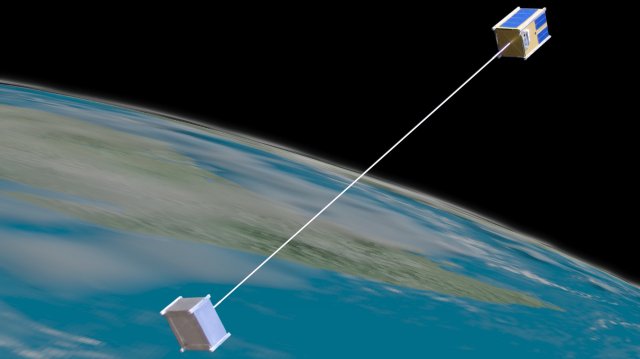
Artificial gravity in space could be achieved using a Kevlar tether, but there are significant challenges to consider. The acceleration provided by the rotating tether would need to be equivalent to Earth's surface gravity to be comfortable for astronauts. While it is theoretically possible to create such a system, in practice, there are several obstacles.
On Earth, we cannot shield ourselves from Earth's gravitational influence, as there are no negative gravitational charges or forces. When in free-fall conditions, such as within a closed room, observers experience no net acceleration relative to their surroundings and cannot tell if they are at rest or in motion. This sensation of weightlessness is what humans experience in space.
The long-term effects of spaceflight on the human body are profound and negative. These effects, known as RIDGE (Radiation, Isolation, Distance, Gravity, and Environment), include radiation exposure, psychological effects from isolation, the challenges of distance from Earth, reduced gravity, and the psychological and physiological strain of being in a confined space.
Gravity serves many essential functions on Earth, such as proprioception, which allows us to know where our body begins and ends and how forces applied to our body relate to our body's motion. The normal force pushing back up on us when we lay down, sit, stand, walk, or run strengthens our muscles and bones and provides a stable equilibrium.
In zero-gravity, astronauts experience continuous nausea and difficulty falling asleep due to the lack of a "down" position. Disruption of the body's equilibrium of fluids affects everything from space anemia to sinus illnesses and the urgent need to urinate, risking dehydration.
While it is possible to generate artificial gravity using a Kevlar tether, the practical challenges make it a difficult solution to implement.
Rewritten by urgent.news; may contain errors — check the original.
Source: bigthink.com