Life Is Asymmetric. The Scientists Who Figured Out Why Won the 2026 Nobel Prize in Chemistry
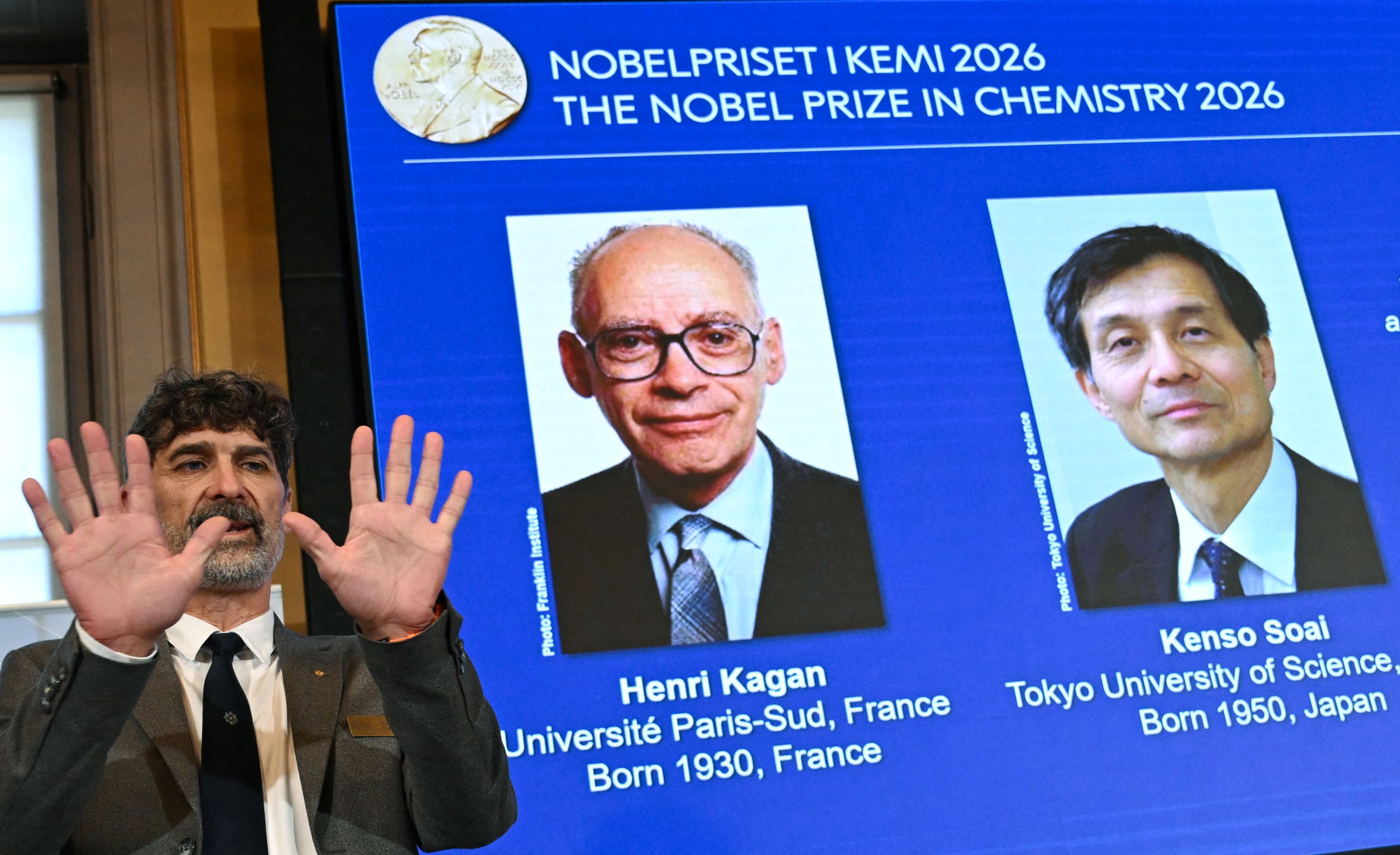
Henri Kagan and Kensō Soai designed chemical reactions producing only one of the two mirror-image forms of a molecule—an important finding for the synthesis of pharmaceuticals and other biological substances.
Molecules can have a left-handed or right-handed form, known as enantiomers, but most life forms only contain one type. This phenomenon, called homochirality, is challenging to control in the lab, as starting with equal amounts of both enantiomers often results in equal proportions in the end product. The discovery of chiral molecules dates back to Pasteur, who found that two enantiomers reacted differently when interacting with bacteria.
Since then, scientists have tried to replicate homochirality, but early attempts yielded equal amounts of both variants. German chemist Willy Marckwald invented an asymmetric reaction using a chiral catalyst, which slightly favored one enantiomer. Theoretical physicist Charles Frank later proposed a model with three conditions for achieving homochirality: an asymmetric reaction, amplification of the imbalance, and autocatalysis.
Henri Kagan investigated these conditions and discovered the "nonlinear effect," where a mixture of both chiral molecules could favor one type due to interactions between a metal catalyst and the chiral substance. Kensō Soai built on Kagan's work and developed a reaction where the product itself catalyzes the formation of the same enantiomer, leading to near-absolute purity in 2003.
The Nobel Committee highlighted that only nature had achieved this before, awarding the 2026 Nobel Prize in Chemistry to the scientists behind these discoveries.
Written by urgent.news from Wired's reporting — not their text. Machine-written — may contain errors; check the original before relying on it.
This story
This is one outlet's version. Read the fullest account.