Altersforschung: 194-jährige Schildkröte: Was Jonathan übers Altern verrät
Fast 200 Jahre alt und immer noch fit: Eine Riesenschildkröte fasziniert Altersforscher. Nun will man aus ihren Genen lernen.
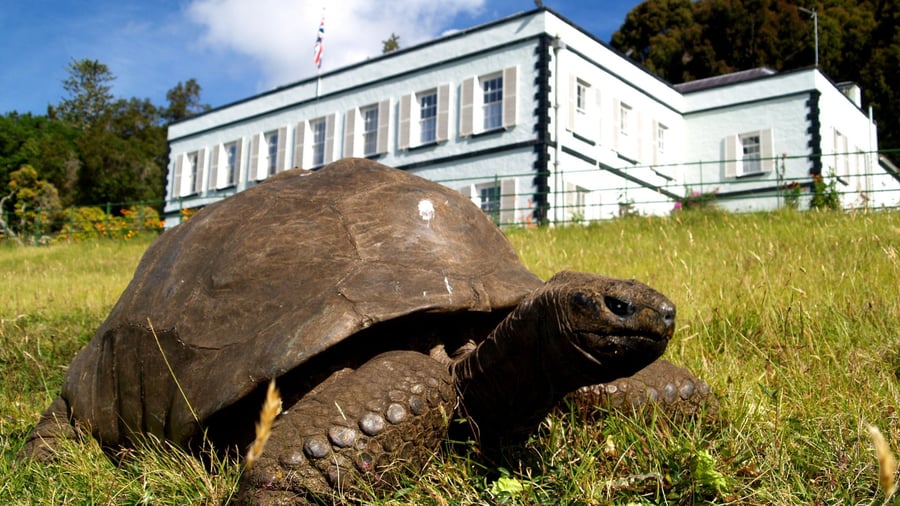
The Aldabra giant tortoise, Jonathan, is estimated to be around 194 years old and is a prized research subject for scientists. Studying this ancient creature offers insights into the process of aging and how it operates in an organism that reaches such an impressive age. Jonathan is currently believed to be the oldest known land animal in the world, as reported in the scientific journal "Science Advances."
Researchers estimate he hatched in 1832, making him a contemporary of Charles Darwin (1809-1882) and Queen Victoria (1819-1901). In 1848, the tortoise was brought from the Seychelles to St. Helena, a volcanic island in the South Atlantic and a British overseas territory, as a gift for the Governor. With the promise of food and samples taken, a team comprising researchers from the University of Cambridge and the Longevity Research Organization Kallel analyzed Jonathan's genetic samples gathered from cheek swabs.
Jonathan was lured with the promise of food until his mouth was wide enough to allow for cheek swabs to be taken, according to a study announcement. Blood samples could not be taken due to regulatory limitations. The researchers also compared Jonathan's genetic samples with those of four other tortoises - a juvenile, a twelve-year-old, and two older males, who were still significantly younger than Jonathan.
All of them, including Jonathan, live in zoos or similar facilities. Remarkably, Jonathan's epigenome, the set of markers on his DNA that influence which genes are turned on and off, closely resembles that of younger tortoises. Typically, the epigenome changes significantly over the course of aging, but Jonathan's remains remarkably stable.
This stability in his epigenome, says the authors, is one reason why things don't function as well in older bodies as they do in younger ones. The state of Jonathan's epigenome is considered particularly remarkable, with Co-author Justin Gerlach of the University of Cambridge stating, "We found that the regulators of energy production and DNA repair remain incredibly stable in Jonathan over nearly two centuries."
During analysis, the team discovered 287 gene variants that slow down typical aging processes, including those involved in DNA repair, reducing inflammation, and suppressing cancer. Unlike previous studies, this is the first time the epigenome of a giant tortoise has been examined in such detail. Despite these genetic insights, the reason why Jonathan has lived so long remains a mystery.
"He could be the oldest giant tortoise ever, or entirely ordinary - until recently, no one has documented the age of tortoises," Gerlach explained upon inquiry. For now, researchers assume that Jonathan is about twice as old as most of his species typically become, at nearly 200 years old. Hope for translatable insights Stephen Clark, founder of Kallel, explained that the aim is to transfer such insights into treatments for humans.
From genetic codes of aging processes in a tortoise to practical applications, there is still a long way to go.
Written by urgent.news from Handelsblatt's reporting — not their text. Machine-written — may contain errors; check the original before relying on it.