Mars’s oddest cloud may be even odder than we thought
Scientists using the European Space Agency's Mars Express , in combination with a state-of-the-art meteorological model of the Red Planet, have found that there may be some very exotic physics behind Mars’s most curious cloud.
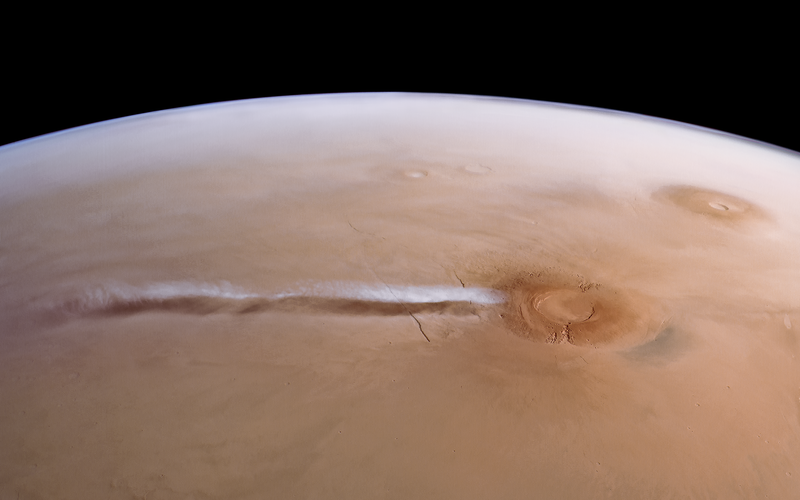
Scientists employing the European Space Agency's Mars Express spacecraft, alongside a sophisticated meteorological model of Mars, have discovered a potentially unusual explanation for Mars's most enigmatic cloud. This peculiar phenomenon, known as the Arsia Mons Elongated Cloud (AMEC), emerges annually in the southern hemisphere during the Martian dusty season.
The distinctive white wisps of water ice stretch up to 1800 km in length, making it the most visually striking cloud on the Red Planet. Discovered by Mars Express in 2018, the AMEC has been observed repeatedly since then, forming, evolving, and dissipating daily for several months.
First identified as an orographic cloud, similar to those seen on Earth, the AMEC's formation is believed to occur through a process called heterogeneous nucleation, which typically requires additional particles in the atmosphere for water vapor to condense onto, such as dust. However, recent simulations have shown that the formation of the AMEC might be due to a different kind of nucleation process, known as homogeneous nucleation.
In this process, water vapor converts directly into icy cloud particles without an intermediary step, a phenomenon previously expected only in the upper atmospheres of Earth and Venus.
The study, led by Jorge Hernández-Bernal from LMD/CNRS/Sorbonne Université in Paris, France, suggests that the AMEC forms under extreme humidity conditions, over 100,000 times higher than what humans experience on Earth. The researchers found that the unique combination of Mars's thin atmosphere and the towering height of the nearby Arsia Mons volcano creates the necessary conditions for this rare process to occur.
As winds flow past Arsia Mons, a powerful wave lifts moist air several kilometers into the air, rapidly cooling it and causing humidity levels to spike. This triggers the spontaneous freezing of water vapor directly into cloud particles, giving rise to the AMEC.
Although some aspects of the modeled cloud don't perfectly match the observations, the researchers consider the result a significant achievement. Mars Express's cameras, including the Visual Monitoring Camera, High Resolution Stereo Camera, and OMEGA, have provided detailed images of the AMEC, including the first ESA release featuring high-resolution stereo camera (HRSC) imagery.
This breakthrough highlights the importance of considering unconventional processes when studying planetary atmospheres, including those of exoplanets. The findings were published in Nature Geoscience.
Written by urgent.news from ESA Space Science's reporting — not their text. Machine-written — may contain errors; check the original before relying on it.