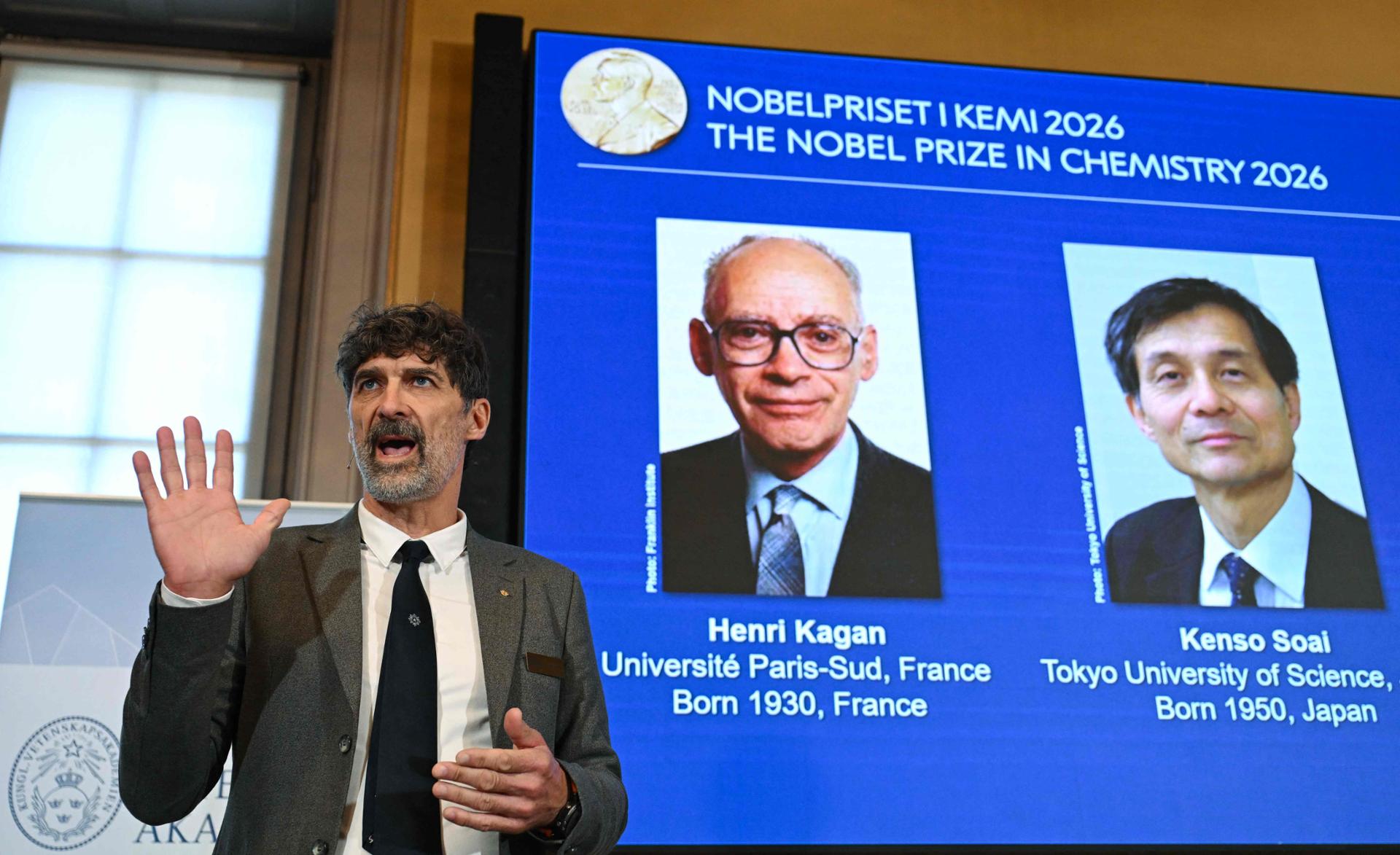
Kagan, Soai Win 2026 Nobel Prize in Chemistry for Discoveries Related to Asymmetric Organic Synthesis
Henri Kagan, PhD, and Kenso Soai, PhD, shared this year's award for the discovery of non-linear effects and autocatalysis in asymmetric organic synthesis respectively. The post Kagan, Soai Win 2026 Nobel Prize in Chemistry for Discoveries Related to Asymmetric Organic Synthesis appeared first on GEN - Genetic Engineering and Biotechnology News .
In 2026, the Nobel Prize in Chemistry was awarded to two scientists for their groundbreaking discoveries related to asymmetric organic synthesis. The prize was given to Henri B. Kagan, a professor emeritus at Université Paris-Sud, and Kenso Soai, a professor emeritus at Tokyo University of Science. Their work focused on understanding the emergence of homochirality, a phenomenon where living organisms contain only one type of mirror image for small molecules like amino acids, while the other type is rarely found in nature.
Kagan's contribution to the field was his discovery of nonlinear effects in asymmetric organic synthesis. In 1986, he found that the relationship between the proportions of enantiomers in a product and the catalyst used was not linear, as previously believed. Instead, he discovered that certain combinations of enantiomers in the catalyst could enhance the formation of one enantiomer over the other.
This led to the development of at least three asymmetric reactions with non-linear effects, which were considered spectacular by experts in the field.
Soai's work built upon Kagan's findings and led to the development of autocatalysis in asymmetric organic synthesis. In 1995, he discovered that a chiral substance could create itself through an autocatalytic process, even in the absence of natural conditions. This discovery culminated in the creation of the Soai reaction in 2003, which resulted in an excess of one enantiomer and allowed for the first time the generation of chirality from achiral or racemic conditions outside of nature.
Their combined efforts have provided a solution to a chemical mystery that has persisted for over a century, and their discoveries have been beneficial for scientists designing reactions used in manufacturing to develop new drugs, flavors, scents, and other materials.
Written by urgent.news from GEN Biotechnology's reporting — not their text. Machine-written — may contain errors; check the original before relying on it.