Galaxy Evolution Can be Affected by Black Hole Jets
In recent decades, astronomers have found evidence that supermassive black holes can really mess with their galaxies' evolution. They gobble up material intended for star formation, quenching the birth of stars. Conversely, jets streaming away from those hungry monsters can also energize gas-rich regions and enhance the chances of a galaxy birthing batches of stars in those areas.
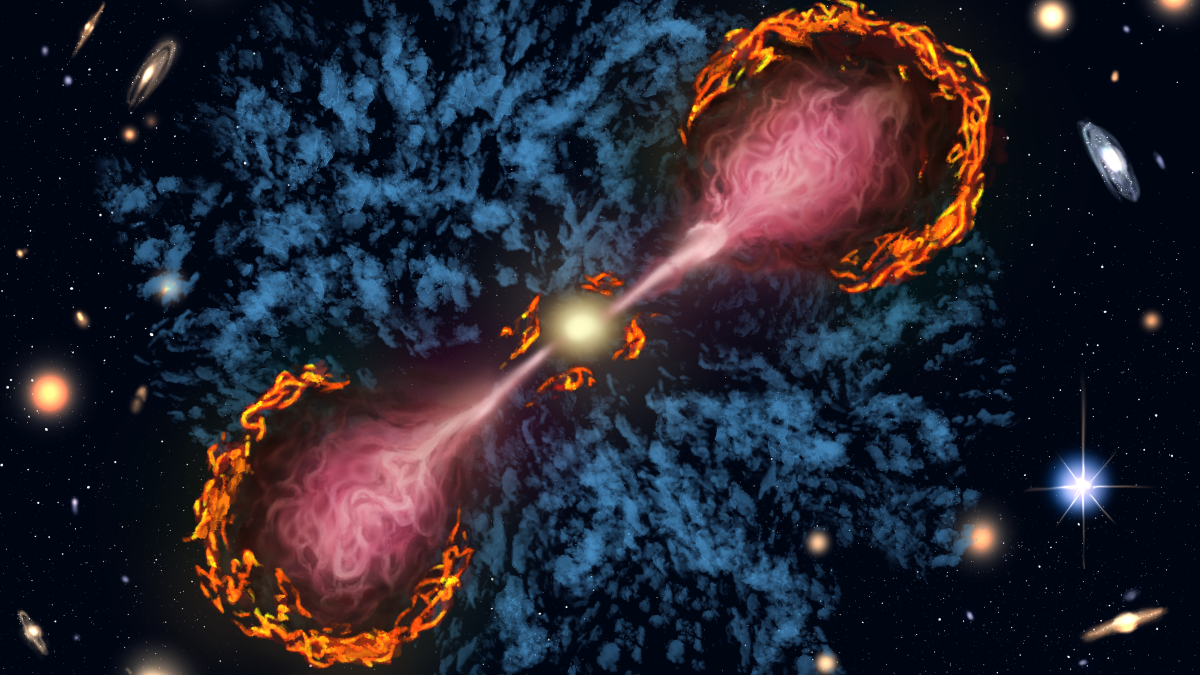
Recent research has revealed that black hole jets can significantly impact the evolution of galaxies. These jets, emitted from supermassive black holes, can heat up and disrupt the gas in the circumgalactic medium (CGM), which surrounds galaxies. The CGM is a vast reservoir of baryonic material, contributing to a galaxy's long-term evolution by providing fuel for star formation.
Astronomers from Arizona State University and the Raman Research Institute in India analyzed data from the Dark Energy Spectroscopic Instrument (DESI) and the LOFAR Two-meter Sky Survey to study the effects of these jets on the CGM. They discovered that the jets interact with the CGM, heating and perturbing the gas along their paths, which can either promote or quench star formation depending on the specific conditions.
This interaction demonstrates the immense power of supermassive black holes and their jets, which can extend hundreds of thousands of light-years from the galaxy. The findings suggest that the jets' influence on the CGM can either accelerate or halt the galaxy's growth, depending on whether they are heating or disrupting the gas supply.
Written by urgent.news from Universe Today's reporting — not their text. Machine-written — may contain errors; check the original before relying on it.