Federated Query at Petabyte Scale: A Deployment Pattern for a Governed AI-Agent Data Layer
A federated query architecture can reduce data duplication and latency while creating a governed, auditable data layer that enterprise AI agents can safely access.
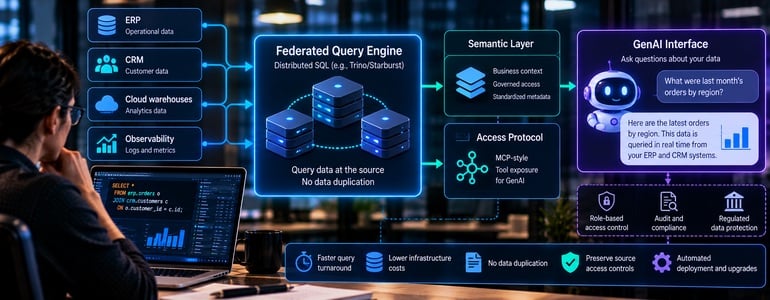
Enterprises grappling with data dispersed across ERP, CRM, cloud warehouses, and observability platforms confront a persistent issue: as data volumes swell into the tens of petabytes, conventional ETL-and-centralize methods result in unacceptably slow query response times and inflated infrastructure expenses. This article details an automated deployment framework for a distributed SQL query engine (federated query architecture) that queries data at its origin instead of replicating it, designed and operated by a DevOps engineer at a healthcare technology firm.
It further explores how this data layer was scaled into a governed, agent-accessible interface for enterprise Generative AI (GenAI), employing a semantic layer and tool-exposure protocol (MCP-style) to link a conversational AI interface to real-time business data. The architecture safeguards role-based access control and audit requirements suitable for regulated (healthcare-related) data. The contribution is a reusable deployment and governance pattern, not a specific vendor product.
A business intelligence team at a healthcare technology company expanded to aggregate data from various ERP/CRM systems, cloud data warehouses, and observability/logging platforms, amassing approximately 30 petabytes of federated data. The data and analytics department supporting this initiative comprised 30-35 individuals; the automated deployment framework and federated query infrastructure were developed and maintained by the author as the team's DevOps engineer.
This expansion outpaced the data architecture's capacity to accommodate the influx: each new source system necessitated unique connector requirements, access models, and definitions of "current" data. The conventional solution of centralizing by building a pipeline that duplicates data into a single warehouse and querying the copy proved ineffective at this scale.
Query turnaround became unpredictable, with no consistent minimum time frame. Delays arose from waiting for batch ETL cycles, requesting manual data pulls from other teams, or manually stitching together exports. Storage and pipeline maintenance were duplicated, as centralizing necessitated maintaining secondary copies of already-owned data.
Fine-grained access controls that existed at the source often failed to transfer cleanly to the shared warehouse, resulting in either excessive permissions or the need to build an entirely new permission system. Federated query, where the engine queries data directly at the source rather than copying it, resolves the duplication and stale data issues but shifts the burden to operating the query engine reliably.
When this project commenced, distributed SQL engines tailored for this pattern (Starburst/Trino-based architectures) were still emerging, with scant documentation focusing on reproducible, automated, and safe deployment procedures. This work directly addressed the gap by creating a repeatable, automated, and safe deployment process.
Written by urgent.news from DevOps.com's reporting — not their text. Machine-written — may contain errors; check the original before relying on it.