Deutschland-Gipfel: Jetzt live: Debatte beim Deutschland-Gipfel mit den CEOs von Allianz, BASF und VW
Deutsche-Bank-Chef – Linken-Regierung in Berlin „kann problematisch werden“ +++ Ökonomin Weber: AfD und Linke nicht gleichsetzen +++ Verfolgen Sie die wichtigsten Ereignisse hier live.
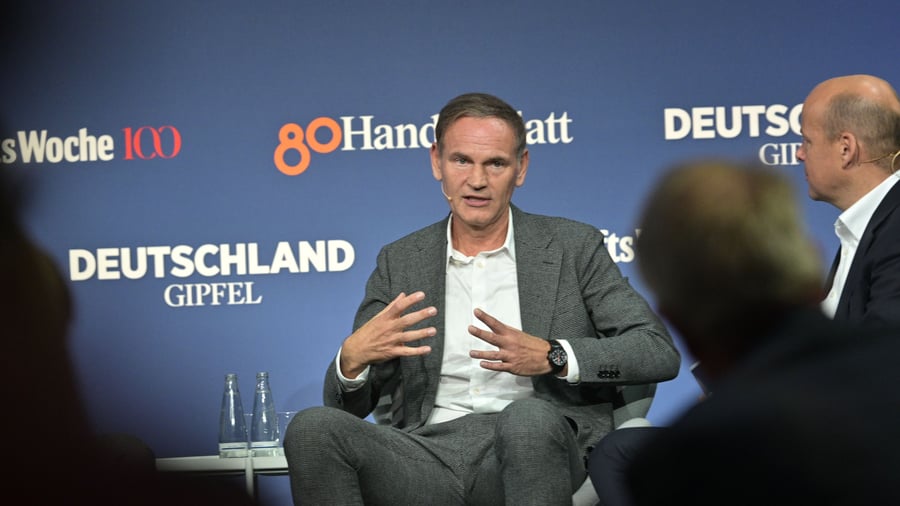
On the Germany Summit held by Handelsblatt and Wirtschaftswoche, German economists and leading business leaders called for more courage and speed to revitalize the German economy. Deutsche Bank CEO Christian Sewing advocated for strengthening the European single market and positioning Germany as a "driving force in global trade" within Europe.
Sewing considered the "Made for Germany" initiative, launched a year ago, a good approach to aligning economy and politics. Henkel CEO Carsten Knobel emphasized the need for reliable framework conditions and competitive energy prices in his vision for the future. Economist Isabella Weber called for stabilizing energy prices and more investments in renewable energy.
Marc Billeb, representing PwC Deutschland, concluded that "We need more investment in the world of tomorrow." Sewing added that Germany must work more hours, as otherwise, it would not be able to compete globally. Knobel echoed this sentiment, stating that "A 40-hour workweek is no bad thing." Harvard economist Ludwig Straub clarified Germany's current stagnation phase, noting that the country had a lost decade due to China's rise, an aging population, and the Ukraine war.
Despite this, he believed Germany's economy could still grow if companies were allowed to respond flexibly to new challenges. Straub identified deregulation, less bureaucracy, a broad industrial base, and tax incentives for investment as key factors for Germany to utilize its potential and unlock new growth areas. He added that the country should orient itself towards Switzerland, which he believed would significantly improve the lives of Germans.
Overall, Straub urged Germany to act boldly, as even a slight growth would be a significant improvement compared to other nations. In the past year, Germany's economy grew by 0.2%, while Switzerland's grew by 1.6%. At the Germany Summit, Bayer CEO Bill Anderson observed a phenomenon in Germany and other Western nations: people no longer take pride in the country's technological achievements but rather expect the state to provide everything.
He argued that Germany needs a clear mission and stronger individual responsibility. Following his approach at Bayer, Anderson suggested that companies should move away from hierarchies and instead have operational decisions made by teams, with employees seeing themselves as owners. He emphasized that Germany, like Switzerland, should have a shared mission that everyone can identify with and take responsibility for.
The Handelsblatt Research Institute, in a joint study with consulting firm Oliver Wyman, found that, despite challenges, the opportunities for the German economy are good. The study highlighted eight growth areas in which Germany could achieve economic resurgence: Industrial Artificial Intelligence, Physical Artificial Intelligence, Semiconductors and Photonics, Automotive Industry, Healthcare, and more.
Written by urgent.news from Handelsblatt's reporting — not their text. Machine-written — may contain errors; check the original before relying on it.
This story
This is one outlet's version. Read the fullest account.