Nobel Prize In Physiology: A Deeper Mapping Of The Brain
The Nobel Prize in Physiology or Medicine illuminates every year a landmark achievement in the field, and this year’s honour has gone to three scientists whose work on light-sensing proteins and optogenetics promises to advance neurological studies and therapies. Optogenetics involves the use of light to switch cells on and off; the transmission of light in the cell is made possible by proteins…
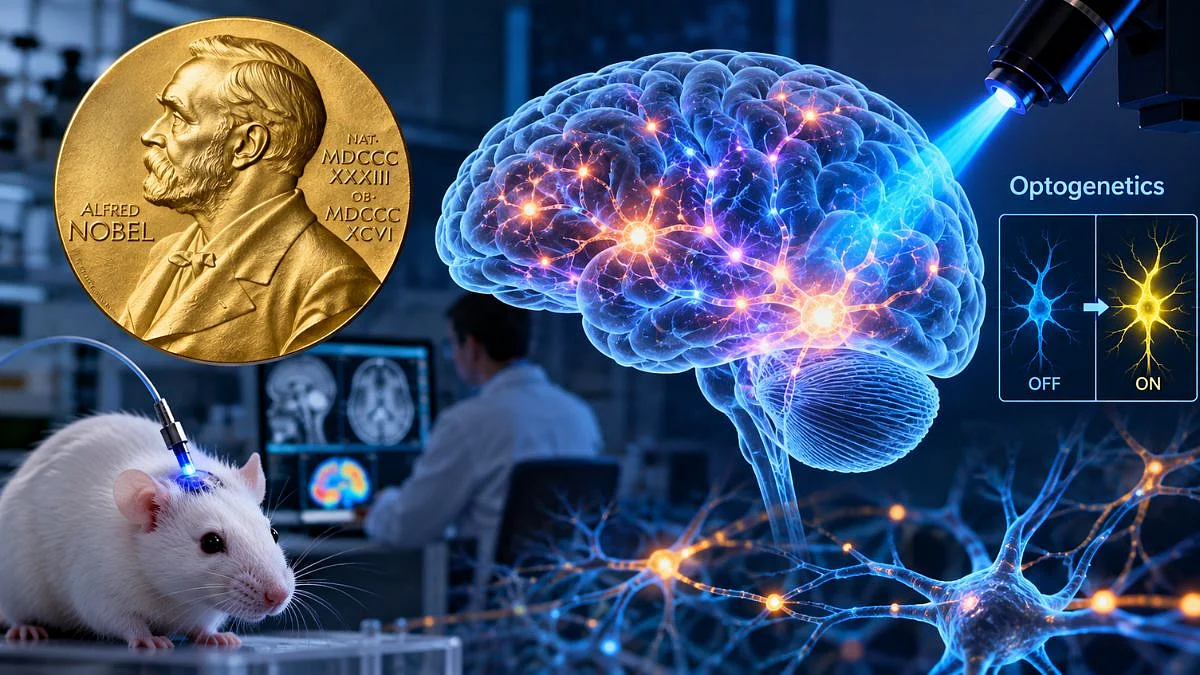
The Nobel Prize in Physiology or Medicine has been awarded to three scientists whose groundbreaking work on light-sensing proteins and optogenetics is set to revolutionize neurological studies and therapies. Optogenetics involves the use of light to control cells, made possible by proteins such as rhodopsins. The work of Karl Deisseroth, Peter Hegemann, and Georg Nagel, researchers from Stanford University in the US, Humboldt, and Wurzburg universities in Germany, respectively, has allowed for the study of neurons and neural pathways, and the analysis of functions such as eating, aggression, and sociability.
Their foundational research laid the groundwork for understanding conditions such as Parkinson's and epilepsy, thanks to the new research pathway they established. The advent of optogenetics has made brain mapping possible at an unprecedented level, allowing scientists to delve deeper into the complexities of the brain. In the 1990s and 2000s, Hegemann and Nagel discovered that a single-celled alga, Chlamydomonas, swam towards light due to a protein called channelrhodopsin.
This discovery was further expanded upon when Deisseroth genetically engineered rats to produce this protein and studied specific nerves that could be activated by shining light.
This new discipline of research has opened up possibilities for deeper understanding and potential therapeutic treatments for neurological conditions. In psychiatry, optogenetics has helped improve our understanding of disorders such as depression, schizophrenia, and Alzheimer's. Following the initial discovery of light-sensitive proteins, more have been found that respond to various colors, enabling targeted research.
Promising work has also been done in using optogenetics to treat retinitis pigmentosa, a condition that causes vision loss due to the death of light-sensing cells in the eye. This experimental area involves injecting DNA encoding for light-sensitive proteins, which allows retinal neurons to sense light and transmit it to the brain, restoring some vision.
The impact of optogenetics on neurological studies is profound due to the intricate nature of brain functioning, which influences many aspects of life. The Nobel Prize is a recognition of groundbreaking research that, while not immediately comprehensible to all, expands the frontiers of basic science. This recognition is eagerly anticipated by nations with a scientific bent of mind, inspiring countless young researchers to pursue deeper inquiries.
The culture of rationality and scientific thought that optogenetics fosters empowers society in fundamental ways, shaping the future of neurological studies and therapies.
Written by urgent.news from Free Press Journal's reporting — not their text. Machine-written — may contain errors; check the original before relying on it.