NASA’s Webb Captures Commotion From Nebula’s Stellar Jets
A cauldron of cosmic creation is being revealed in a new image from NASA’s James Webb Space Telescope. Webb has unveiled numerous stars formerly hidden by clouds of dust in a stellar nursery known as NGC 7129, which resides about 3,300 light-years from Earth. Stars, the engines of elemental creation, have life cycles that begin […]
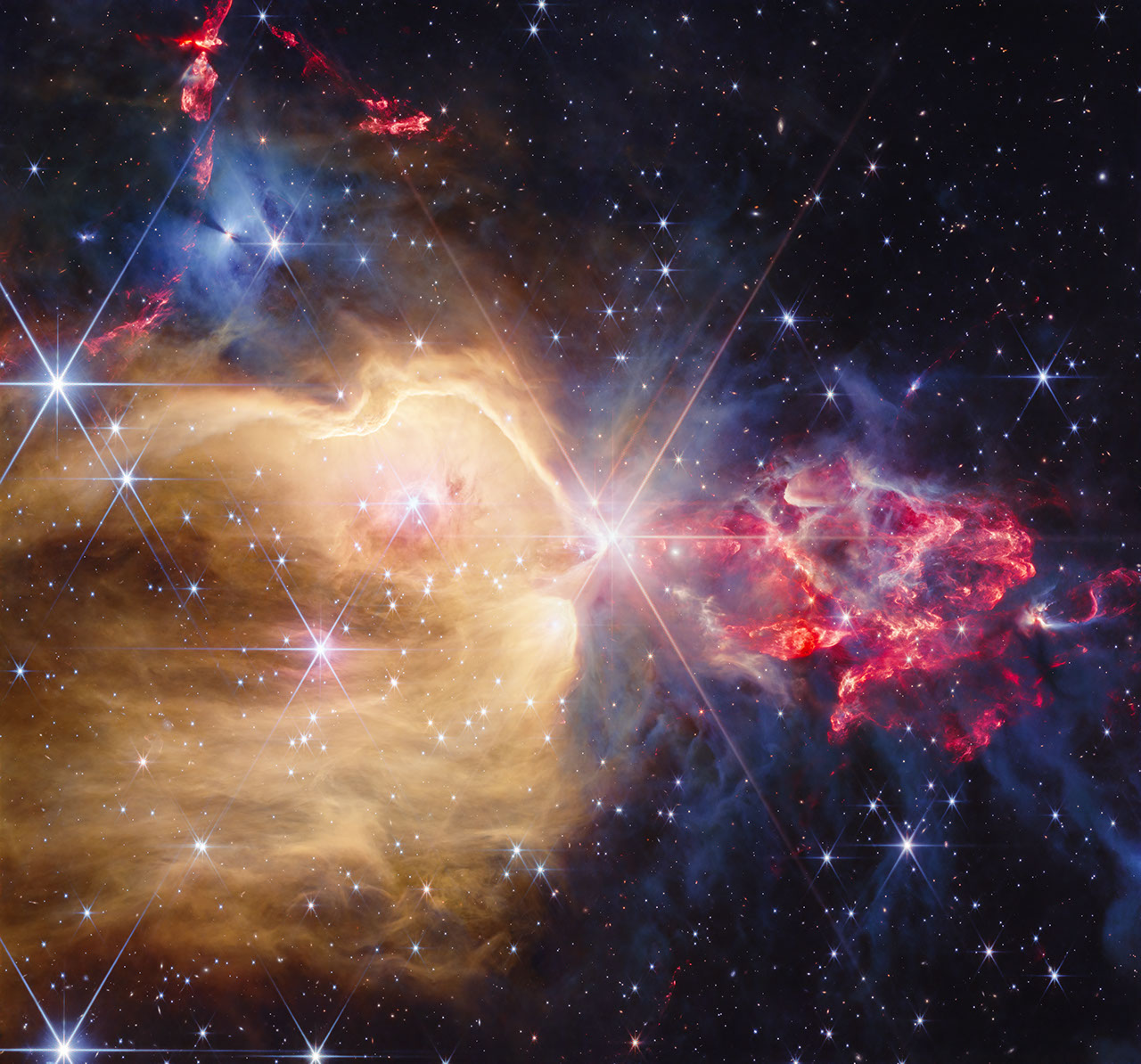
NASA's James Webb Space Telescope has revealed a bustling stellar nursery named NGC 7129, located 3,300 light-years away from Earth. By detecting infrared light, the telescope was able to pierce through the dense clouds of dust, allowing for a clearer view of the region's various stages of stellar development.
The central star, LkH(alpha) 234, is the most massive and evolved, weighing between 5 to 8 times our Sun. As these massive stars form and evolve, they create a luminous pattern that stands out as the proudest diffraction in the image. Pre-main-sequence stars, which are mostly completed their mass gathering process and are contracting under gravity, can also be found in this region. These young stars will eventually begin fusing hydrogen like our Sun.
The cavity to the left of the central star is the star's most significant impact, with outflows from an earlier stage of its life cycle carving into the dense molecular cloud of hydrogen. As these outflows and the star's light energize the gas, it glows, while much of the hydrogen gas is blown away, creating compressed conditions for even more stars to form.
The region right of the central star is a different chaotic tale, showcasing clumpy red matter hiding younger objects known as protostars. Protostars form before pre-main-sequence stars and occur when molecular clouds of gas and dust compress and fragment. As these protostars gather matter, they eject outflows of superheated material, interacting with the dense matter surrounding them and creating shocks that give the region its textured appearance.
The red glow is also due to the interaction, similar to the outflows of the central pre-main-sequence star. Multiple outflows from various stars overlap from our viewpoint, causing the chaotic appearance.
Written by urgent.news from ESA Space Science's reporting — not their text. Machine-written — may contain errors; check the original before relying on it.
This story
This is one outlet's version. Read the fullest account.